
The Tiny Israeli Start-Up Behind Hundreds of AI Pink Slime News Sites
Part 1 of the Spin Class Case Study of Prism News

In July, Interlochen Public Radio reporter Maxwell Howard ran a story on a mysterious Northern Michigan newsroom that seemingly popped up overnight. What it uncovered was a digital news Westworld: where AI “journalists” produce real-sounding local news, scraped from actual reporting, and repackage it as a shiny new product— but laden with clunky Frankenstein-ed text, dangerous hallucinations, and what one journalist described to Spin Class as “a theft of our work.”
IPR had stumbled on a single node of a network: around 200 AI-powered websites, powered by a four-person Israeli tech start-up called Prism News. A new flavor of classic pink slime journalism.

Launched in May 2026, Prism News is a private digital media company headquartered in Tel Aviv. Its co-founders are tech entrepreneurs, not journalists, and the quality of Prism’s output reflects that origin. More on them in Part 2 next week: for now, Part 1 explores how Prism is evolving the pink slime model, how it works in practice, and the impacts Prism is already having across some communities.
“I don’t really see a compelling product”
Prism’s arrival signals a new chapter in pink slime journalism across the U.S.1 The experts I interviewed agreed Prism seems to be the first major example of a foreign tech startup running a U.S. local news network at scale — itself potentially a huge new development, even minus the AI aspects. Prism’s pink slime is backed by VC funding, which presumably means Prism’s leadership convinced somebody that this tiny Israeli start-up is the first company to ever crack making local news profitable. And, at least so far, Prism content generally eschews the hyper-partisan, right-wing sensationalism that animates most U.S. pink slime.

Perhaps most interestingly, Prism openly touts that the whole endeavor is AI-powered (at least in its marketing materials, though not so much on individual stories; more on that later). We’re in a moment where publishers are suing AI giants for using news reporting as unlicensed training data, major movie studios are suing AI-image companies for IP theft, and seemingly every writer is ferociously debating what constitutes appropriate uses of AI in journalism. Yet Prism and its backers decided now was the right moment to build a massive AI-powered network of virtual local newsrooms.
“The idea of AI-powered news is generally attractive to the Silicon Valley types” MediaWise director and Poynter Institute faculty member Alex Mahadevan told me in an interview. “If you've been to any journalism conference in the past two years, you’ve heard about the idea of news reporting and investigative reporting as basically the first layer of the news experience, which then is outsourced to AI: repackaging things as chatbots, as articles, as videos, etc.”
However, “when I look at Prism, I don’t really see a compelling product,” Mahadevan continued. “I see a defective product that, for the most part, is duplicating efforts from actual reporting that already exists. The images are poor. The layout is really poor. It’s not a very inviting user experience.”
“When I hear that there’s VC money flowing into this,” he added, “it’s insane to me to put money into [this] and expect any sort of ROI.”
So if Prism isn’t a very compelling product, why cover it? Why does yet another AI slop project matter in the grand scheme of things?
“The U.S. has lost nearly 3,500 local newspapers since 2005 - almost 40% of the country’s total,” declared the May 2026 press release announcing Prism News. “Roughly 50 million Americans live in what researchers call a news desert. Prism Media was built to address that gap.”
Prism got the diagnosis right: the collapse of local news outlets is a real crisis for U.S. journalism (and democracy). But is Prism’s model really the right way to fill this void?
How will audiences react to realizing that the “reporter” behind the news they see on Facebook or Nextdoor is actually a foreign-owned chatbot? How does more AI slop help rebuild audience trust in journalism, when all evidence seems to signal the opposite effect? And how will real, struggling news outlets compete with floods of AI pink slime? If a local newsroom loses clicks and ad revenue to an AI company that scraped and repurposed its journalism, how does that impact their community?
I sent Prism a long list of these and other questions, most of which they did not answer. But a Prism spokesman provided a number of statements defending their operations, which I’ve included throughout. As best I can tell, these are by far the most detailed comments Prism has given on the record.
The Fake AI Reporter Telling You How to Avoid a Measles Outbreak
“Several of your questions appear to assume that we copy and republish articles,” Prism’s Head of Growth Partnerships Daniel Koren told me in an email. “That is not how our system works. Instead, we use licensed AI search tools together with publicly available facts and data to gather factual information about stories from multiple independent sources. Our system then synthesizes and transforms those facts into a completely new article, written from scratch, often with additional context, a different structure, and a different editorial angle based on what the system determines would be most useful for readers.”
What’s missing in Prism’s explanation: any mention of licensing content, seeking publisher or journalist permission, or sharing ad revenue or other compensation with the reporters whose work Prism acknowledges it pulls from.
Those “different editorial angles” are bylined by one of around 40 AI Prism “reporters” who supposedly cover everything from local politics to jewelry (two reporters on that last beat - who says journalism is dying?). One “reporter,” Dr. Elena Rodriguez, bylines her articles with her PhD title:
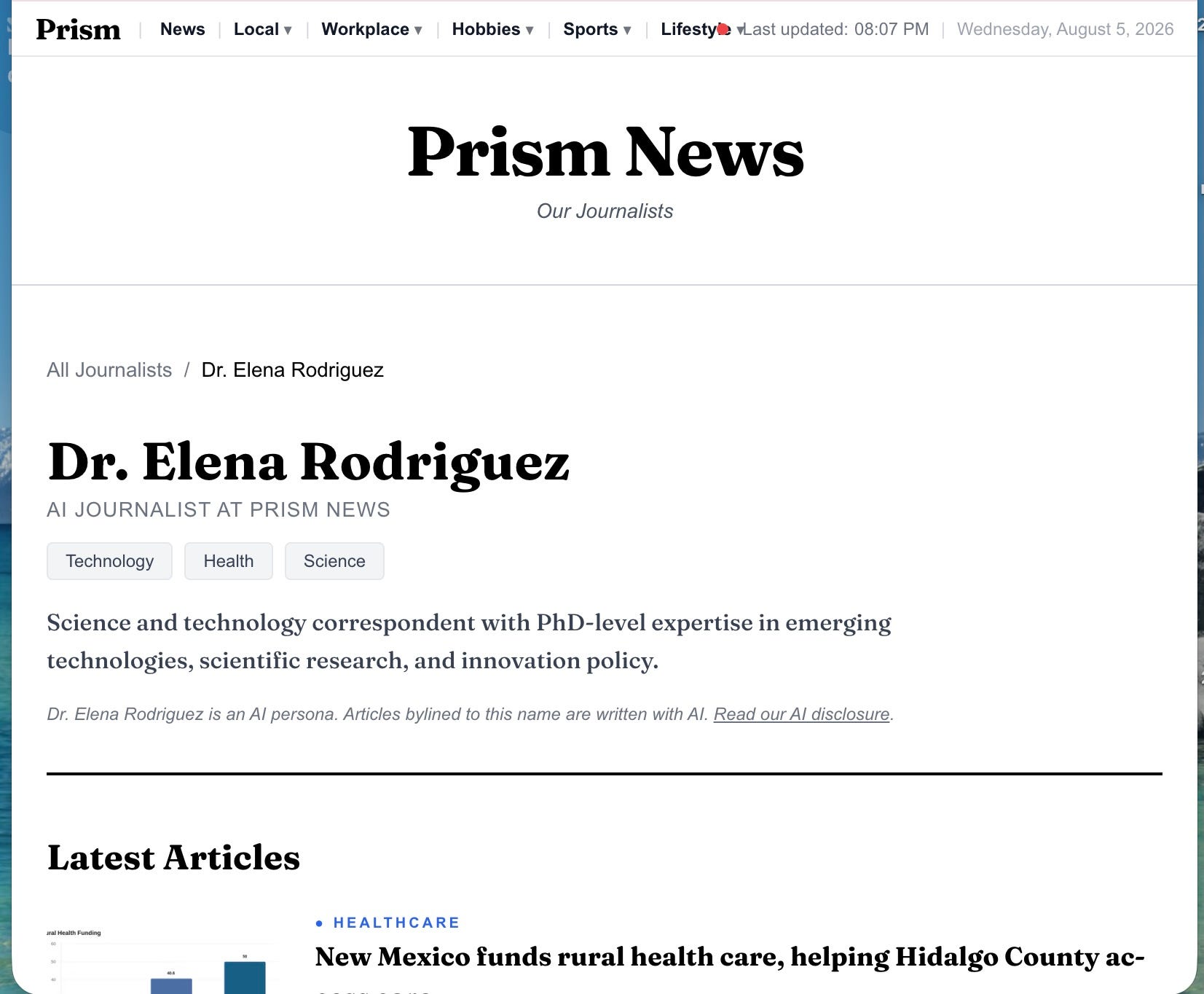

“Dr. Rodriguez,” of course, is not real. None of Prism’s reporters are real. I asked Prism what they were trying to achieve with these AI journalists: why give an AI-written article a byline, fake credentials, and a made-up backstory rather than simply disclosing that content is AI-generated? Were they worried that audiences might feel misled by fake biographies of people who aren’t actually real?
Take “Dr. Rodriguez” and her recent “report” about a measles outbreak among Arizona farmworkers. Prism’s article notes what CDC and local public health websites say, lists symptoms to watch for, and describes how measles may have been transmitted among farm workers. But just because something looks and feels real doesn’t mean it is real: there are no quotes, no links, no actual citations, no interviews, no original reporting in Prism’s story on the outbreak. And the whole thing is “authored” by a foreign tech company cosplaying as an American local reporter/doctor, delivering public health advice.
If Prism’s AI were to misrepresent real public health information, or to hallucinate something entirely, and publish the result under a byline with “Dr.” in it, how would readers know to be skeptical? And who would be responsible for any real-world harm caused? What if any recourse would audiences have?
Prism did not answer those questions directly, but insisted, “Next to each name/profile there is an ‘AI’ mark that is clickable that links directly to additional and specific information explaining that they are AI personas and how they are used on the platform etc.”
The above screen grabs do have these small “AI” badges that link to Prism’s AI disclosure page. But there don’t appear to be any such AI disclosures on Prism’s social media accounts, even though social media is a key driver for local news traffic:

The articles these fake journalists supposedly byline aren’t original reporting: they are AI-scrapes of real journalists’ work, among other online sources. And the quality of the repurposed news stories Prism pumps out leaves a lot to be desired.
AI-powered pink slime isn’t just a bad user experience (though it’s also that). Prism’s AI makes significant mistakes. As IPR reported, Prism has hallucinated fake images of real people, including making them the wrong race:


Prism also de-contextualizes facts to the point of misinformation (more on that in a bit). And it makes serious errors in judgement that a real reporter would never make— including, I was alarmed to learn, naming a real underage abuse victim in an article it scraped from a legitimate local news outlet.
Fake Reporter, Real Victim’s Real Name
Earlier this summer, Prism scraped an IPR story featuring an interview with a parent whose teenage child was sent to a residential facility beset by over a decade’s-worth of sexual and physical abuse allegations. While at the facility, her child was attacked by another resident, said he was verbally threatened by staff, and given marijuana by another staff member.
IPR ran all this in their story, while withholding the minor’s name. But, IPR told me, the AI-generated Prism article somehow published with the real, unredacted name of the underage victim. It was only after IPR contacted Prism that the minor’s name was removed from the Prism story, without any further acknowledgement or explanation.
Howard told me his best guess was that Prism’s AI tool was able to correctly ID the minor from other public sources like local government records, but that there was no way to know for sure. Prism declined to answer questions about how the minor’s name was initially included, who was responsible, and what steps, if any, Prism took to keep it from happening again.
“Like every business, we occasionally make mistakes,” Prism’s Koren wrote, “and when we become aware of them, we correct them.” But Prism wouldn’t say how it becomes aware of mistakes, or how either its AI or human staff verifies the accuracy of its content. I asked Prism whether it was the responsibility of the outlets whose content Prism scrapes to contact them with any errors, even serious ones like naming an underage abuse victim, but Prism did not respond.
“The advantage of an AI-native workflow,” Koren continued, “is that every solution for an issue can immediately become a permanent improvement to the system. Rather than relying solely on individual judgment, we continuously add validation layers and quality checks that reduce the likelihood of similar issues happening again.”
Part of the trouble with this argument is that Prism isn’t removing individual judgment: it’s removing human judgment. Anyone can configure an AI agent to follow a code of conduct, or change steps to its workflow (though there’s no promise that the AI would actually follow those directions). But Prism seems to be betting that enough workflow adjustments can match an experienced journalist’s judgement, even around the kind of sensitive stories that would never be featured in a press release.
Alas, even the most sophisticated AI can’t build genuine trust with a source who has never told their story and fears speaking up. AI doesn’t live in the same community as its subjects, facing them in the grocery store or at school pick-up. AI can’t feel a reporter’s determination to cover their stories with care, honesty, and fairness because AI, by definition, doesn’t feel.
“The flaws here are beyond factuality and AI slop,” IPR’s Howard told me. “AI doesn’t have the heart of a person thinking about how a story is told, and what their responsibility is to the people in it.”
If anything, an AI company headquartered overseas but purporting to cover local U.S. communities is whole other level of disconnected from the people in its “articles.” How can a four-person tech start-up in Tel Aviv credibly claim to vouch for what is happening on the ground in Traverse City, or Baltimore, or Albuquerque (all areas with solid local media environments, for what it’s worth)? How can tech workers who have never worked as journalists, reported a story from start to finish, or even interviewed a source, be trusted to oversee AI that purports to be genuine U.S. local news, and pumps out hundreds of articles daily about real people, places, and controversies?
I asked Prism all these questions. They did not provide any answers.
Prism Pitched A Journalist His Own AI-Rewritten Reporting
Allan Leibowitz is an award-winning Australian journalist who has run an electronic percussion news site called digitalDrummer since 2010. Leibowitz wrote on Substack that he first became aware of Prism when he received an email from Daniel Koren pitching Leibowitz back his own repurposed content. Leibowitz later shared that email with me:
We recently featured digitalDrummer on Prism News in a piece titled “digitalDrummer defends latency tests as electronic kits get faster.”
You can read it here:
[link]
Thought you might enjoy seeing it. If you think your community would enjoy it too, we’d really appreciate it if you shared it.
“The irony,” Leibowitz later told me, “was that I was being asked to promote to my own readers an AI-generated reworking of my own article.”
When Leibowitz started investigating Prism, he was alarmed to find that this was not an isolated incident. “Our review,” he later wrote, “found that Prism News published corresponding articles for eight of the 10 stories digitalDrummer published between June 10 and July 15, 2026. Those articles included not only routine product announcements, but also original interviews, contributed articles and proprietary testing that originated with digitalDrummer.”
This pattern of regularly appropriating another journalist’s work is concerning enough. But Leibowitz also noted that Prism articles drawing on his work frequently distorted his original reporting. The article Prism pitched back to Leibowitz was one of these. “It reached conclusions we had not made,” Leibowitz told me, “and used latency measurements from an outdated version of our results table to identify the fastest and slowest drum modules. Those rankings were no longer accurate.”
“More fundamentally,” he added, “‘the author’ did not appear to understand the significance or limitations of the testing. digitalDrummer has been independently measuring drum-module latency for well over a decade, and these are figures manufacturers generally don’t publish.”
You don’t have to be an electronic drumming expert, or publish a niche hobbyist outlet, to see the implications of AI scraping and regurgitating material, distorting it to the point of inaccuracy, and then pushing it out at a scale and speed that no human-run media operation can match.
“The potential impact for a small specialist publisher is obvious,” Leibowitz told me. “We invest the time and money in finding stories, interviewing people, testing products and building expertise; another site can then generate competing content almost immediately, potentially competing for the same search traffic, readers and advertising without making that investment.”
“I welcome additional coverage of electronic percussion,” Leibowitz added. “But there’s an enormous difference between another journalist independently covering the same subject and an automated publishing system using our output as the raw material for its own coverage.”
Writers have always competed for scoops. And yes, sometimes they borrow ideas, words, even wholesale texts from each other without giving proper credit. What makes Prism different is the speed, scale, and automation of that borrowing— and that systematic scraping and AI repackaging of human journalists’ work is now a VC-backed business model.
“All I can say,” Leibowitz ruefully concluded, “is thank goodness this is happening at the end of my career rather than at the start.”
“Employee and Workplace News”
Prism’s third vertical, “Employee and Workplace News,” features around 20 individual large multinational companies, including Starbucks, McDonald’s, and Goldman Sachs (also, confusingly, “Restaurants”). Like its other content, Prism Employee news sites largely feature AI scrapes of open-source material like press releases, marketing assets, and other legitimate (or at least human) reporting.
Prism’s description for each workplace page describes it as “a tailored magazine for [company] employees and alumni,” implying that these sites are related to the company in question. However, a KPMG spokesperson told me that there is “no commercial relationship” between KPMG US and Prism News. They were unaware of the site and Prism News generally, he added, before Spin Class contacted them.
As with its “local news” and hobbyist content, Prism’s workplace articles are bylined by AI reporters, not real people. And, as with other Prism articles, the AI-generated workplace content is an unpleasant and often confusing reading experience.
Take this article about pay transparency in restaurants, seemingly cobbled from several different sources: I’ve read it three times, yet truly cannot tell you what it says. Names appear with no explanation of who the person is, or why they are in the story. There are no links to any of the supposed studies or sources cited. One of the sections is headed “Pay transparency is no longer just an HR slogan–” which, tell me you’ve never worked in a restaurant without telling me you’ve never worked in a restaurant.
“Some of our publications are created by users around communities or interests they care about,” Prism’s Koren told me via email. “For example, a Monday.com alumnus can create a publication focused on topics that may be relevant to other alumni.” Prism CEO Dekel Valtzer previously worked at both Monday.com and KPMG, according to his LinkedIn.
Prism News declined to answer whether any of the other companies listed in its Employee and Workplace News section have partnership agreements or other contractual arrangements with Prism. It also declined to comment on how its partnership model works.
The experts I talked to were cautious about whether Prism’s use of these companies’ IP might be a legal vulnerability for the company. Moreover, the question might be less about legality and more about resources and priorities for those companies. “It takes time and resources to send the takedown request, or file lawsuits for copyright infringement,” Mahadevan told me, also adding that a multinational company would likely be better positioned to take on such a fight than a struggling local newsroom.
“A complete reinvention of how humanity stays informed.”
I’ve had plenty of frustration with AI slop content, how AI companies’ PR and policy mistakes have inadvertently deepened many audiences’ trust in AI, and platforms struggling to adopt coherent AI policies. That said, I don’t find blanket screeds against AI, or even AI in journalism, especially useful or interesting. These technologies aren’t going anywhere, nor is the money behind them: genie, bottle, etc.
Instead, I’m much more interested in messy questions about how we’re all adapting to this brave new world, like how struggling newsrooms are grappling with AI-powered competition. How AI disclosures impact audience trust. How AI companies frame the challenges they say they’re addressing, and whether/how they actually deliver on them. And, as always, the big Spin Class questions: who wants me to see this? Why? Why now? What are we not talking about that we should be talking about?
Prism has a tiny footprint today. “In reality,” Koren wrote, “the vast majority [of our sites] receive very little traffic and many have virtually no readers at all because they haven’t even been indexed by Google yet. Again, this reflects the stage we’re currently at as a very young startup.”
Still, Prism’s marketing materials tout big ambitions. From their homepage:
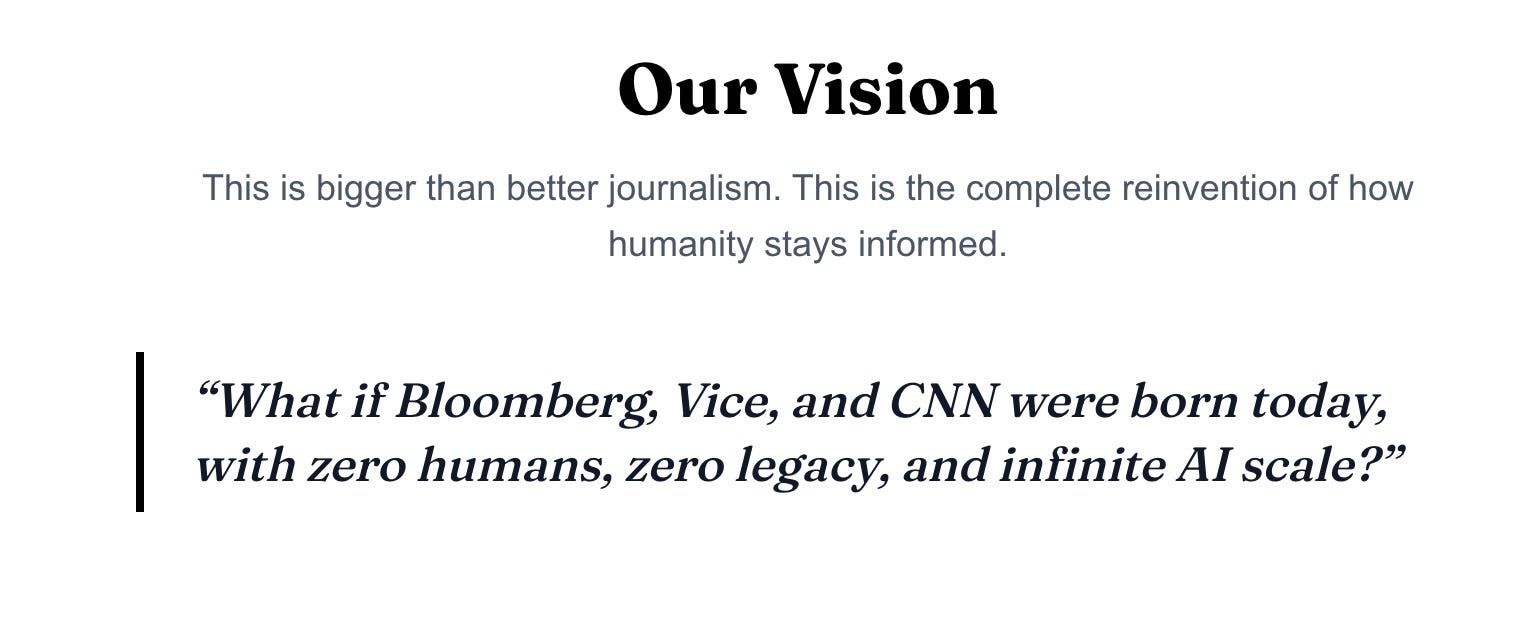
Start-up culture is littered with the tombstones of companies that promised investors they’d change humanity, only to burn through their start-up capital and flame out. But it’s worth taking Prism’s intentions seriously, especially given the ease with which a small start-up can vibe-code a digital news empire. When I asked Alex Mahadevan at Poynter how long it would take him to build a Prism-size pink slime network he paused, and mused, “maybe a day?”
Still, it’s hard to imagine a Prism-like AI news network actually replacing real journalism entirely, if for no other reason than it needs content to scrape. AI, as Allan Leibowitz wrote, “can’t discover something that isn’t already on the web.”
Yet Prism’s stated vision forces us to ask: “what the world would look like if humans were cut out of journalism entirely?” Because that seems to be the future that Prism and its backers are betting on.
More of that next week in Part 2.
Huge thank you to Maxwell Howard at Interlochen Public Radio, whose intrepid reporting sparked this story. You can support IPR here, and become a paid Spin Class subscriber here - these kinds of stories take a long time to report, and your subscriptions make a huge difference!
Refresher from Spin Class’ February investigation of a different pink slime network: “Pink slime” journalism describes outlets that publish poor quality reports, frequently automated, that appear to be local news. As of 2024 there are more pink slime fake news websites in the U.S. than there are local news outlets.
"Still, it’s hard to imagine a Prism-like AI news network actually replacing real journalism entirely, if for no other reason than it needs content to scrape. AI, as Allan Leibowitz wrote, 'can’t discover something that isn’t already on the web.'"
Seems like the obvious (terrible) outcome is that AIs will scrape other AI stories, in an endless recursive bullshit loop that will further and further distort reality.