
Spin Class Case Study: I Caught POLITICO and the New York Times Laundering Pink Slime "News"
How the sexist backlash to AOC and Gretchen Whitmer at the Munich Security Conference led me to a scammy "local news" outlet pushing a coordinated right-wing narrative

I skipped the Munich Security Conference this year, but kept up with the news and gossip. The Tuesday after the conference ended started like any other day: I opened my eyes, opened my email, and scanned the various media and political newsletters that fill my inbox.
But what I saw Tuesday morning was a sea of fury about Alexandria Ocasio-Cortez and Gretchen Whitmer’s event four days prior. It was seemingly everywhere, including in POLITICO Playbook and an exclusive New York Times interview with AOC on the “fallout” from her appearances in Germany, and what AOC and Whitmer’s comments say about Democrats and foreign policy.
Did I miss something? I’d half-listened to their event while folding laundry on Saturday and didn’t think much about it. If anything, it felt reassuring to hear AOC and Whitmer onstage with NATO PermRep Matthew Whittaker, who dutifully recited the necessary administration talking points but minus the vitriol and weirdness I brace for whenever a Trump foreign policy official speaks in public these days. It was downright soothing.
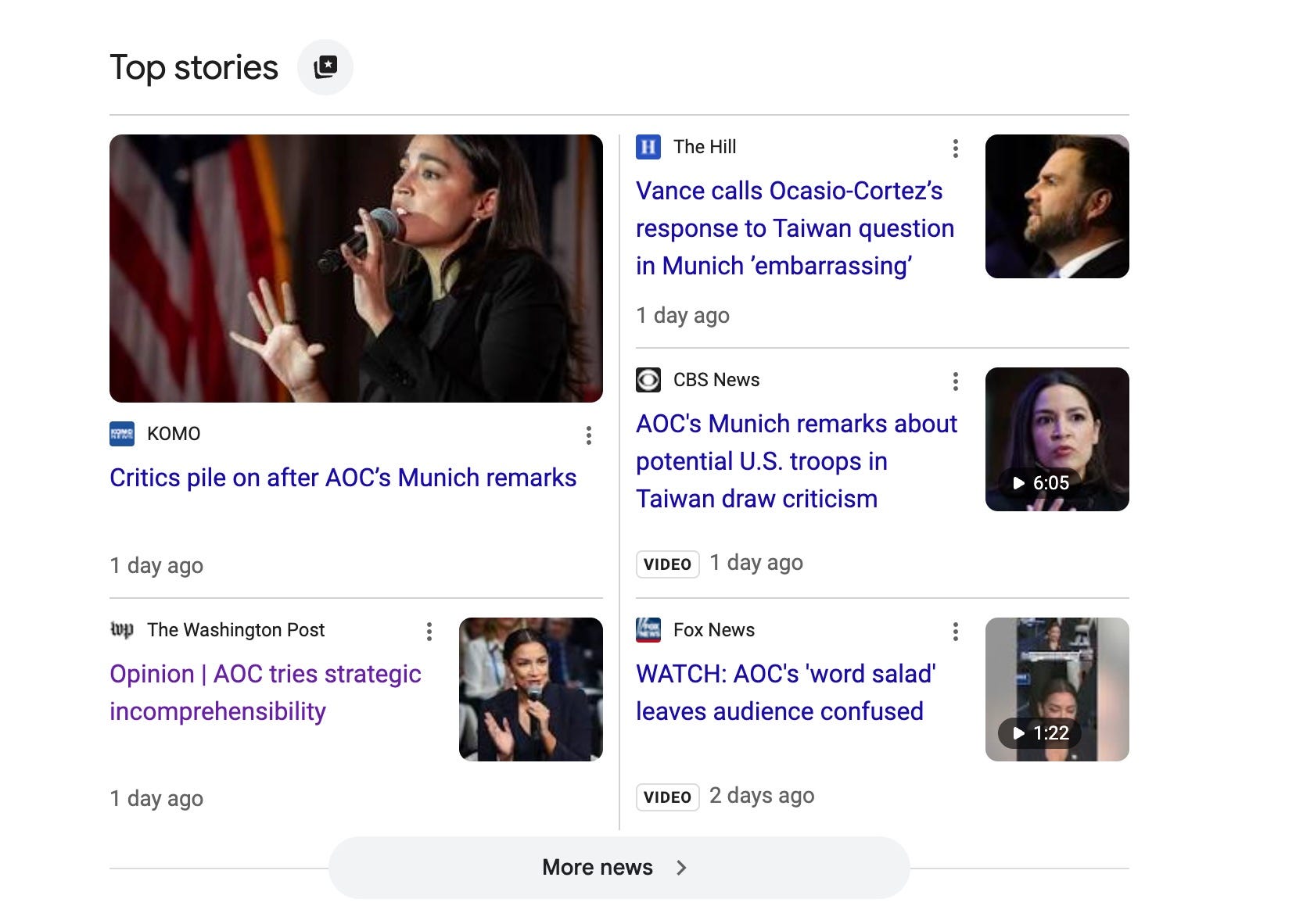
I had indeed missed something: over the long President’s Day weekend, a phalanx of right-wing actors launched a coordinated attack on AOC and Whitmer, driving inflammatory, often sexist social media content that was then amplified by more palatable MAGA and Republican voices until it broke into the mainstream.
And six days later, this narrative has calcified as conventional political wisdom:
We’re going to get into how that happened. But first, let’s talk about pink slime. I promise, this will matter later.
What is Pink Slime?
Per Poynter:
“Pink slime” journalism is named after a meat byproduct and describes outlets that publish poor quality reports that appear to be local news.
As local news sites have either gone out of business or are struggling to survive, and pink slime sites have replaced them.
These outlets claim to cover local and hyperlocal news, sometimes taking advantage of news deserts.
Pink slime sites are frequently produced via automation and templates. Look for text that’s more generic than expected, or articles that are pure information without context — that’s a giveaway you’re looking at a pink slime website.
Often, they’re funded by outside companies with a partisan source of financing.
ProPublica, CJR, Margaret Sullivan (then at the Post), Jane Mayer, and many others have written urgently about the dangers of pink slime, but it’s still not a widely-known term. I teach my students about pink slime in our unit on local news, and media-savvy undergrads are usually horrified to learn that there are more pink slime fake news websites in the U.S. than there are local news outlets.
Pink slime content overwhelmingly has a conservative partisan slant. Most of the known major pink slime networks are funded by right-wing dark money groups and billionaires. Around the early 2020s the biggest known node was Metric Media, owned by Brian Timpone, which as of 2022 owned around 1,300 pink slime websites pretending to be local news outlets (this excellent study by the Tow Center for Digital Journalism at Columbia goes into full detail).1 Those networks were supercharged around the 2020 and 2022 U.S. elections, with Metric Media websites alone reportedly pumping out five million articles a month in the run-up to the 2020 elections.
More recently, pink slime sites have started weaponizing FOIA requests and targeting colleges and universities. As the Tow Center wrote in September 2025:
Six years ago, when the Tow Center started its research into “pink slime” networks of local news sites, it seemed to many of us that these networks could not be real competitors to independent journalism because they were so ineffective and diffuse. We thought the marketing tools they produced for politicians would be limited by low quality and fail to get engagement. But pink slime networks have not withered. Instead, partisan news, whether directly funded by political interests or just indistinguishably aligned with those interests, has become not only acceptable, but actually a predominant force in political campaigning.
Pink Slime and The Post-Munich Narrative
So Tuesday morning, four days after the Munich session featuring AOC and Whitmer, I read this in POLITICO:
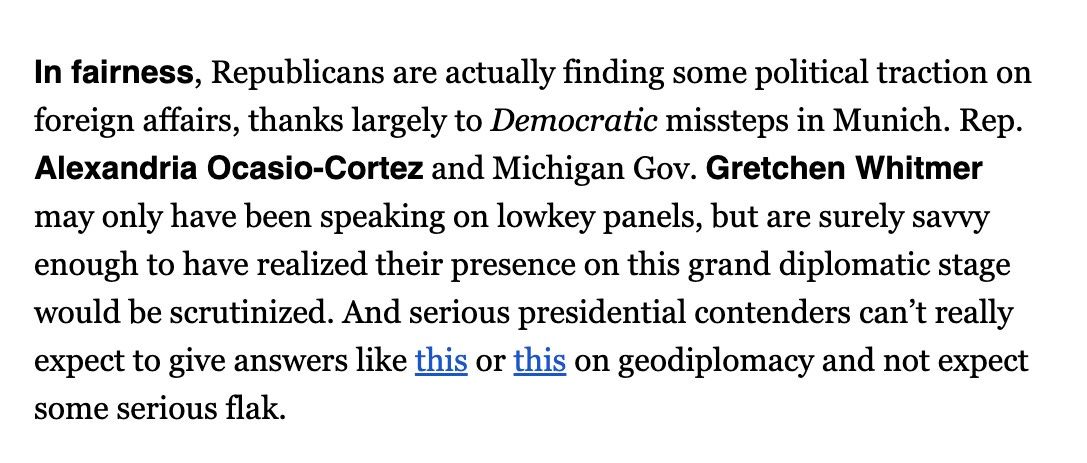
Those two hyperlinks direct to tweets from Eric Daughtery, a right-wing troll whose X bio reads in part “Charlie Kirk: ‘Men Must Vote.” Asking this gentleman what he thought of AOC’s foreign policy comments is like asking Harvey Weinstein what he thought of your daughter’s school play.
But it’s the second POLITICO hyperlink, which was also included in the New York Times’ post-Munich AOC story, that first confused and then alarmed me:

I’m a native Michigander and try to keep up with local news. I’d never heard of this outlet. Nor had any of my family or friends who live there. But that X handle looked sketchy. So I started researching.
The Midwesterner purports to be a Michigan local news outlet. Per the Wayback Machine, the Midwesterner first appeared on February 4, 2023. It appears to have appeared online fully formed, with no announcement or notice. There’s no masthead, About section, or way to contact reporters. There are no ads, paywalls, or paid subscription options.
Many of the links from that first Wayback appearance are now broken, but what remains intact appears to be scrapes of legit local news outlets, most with a sensationalist and/or right-wing headline.
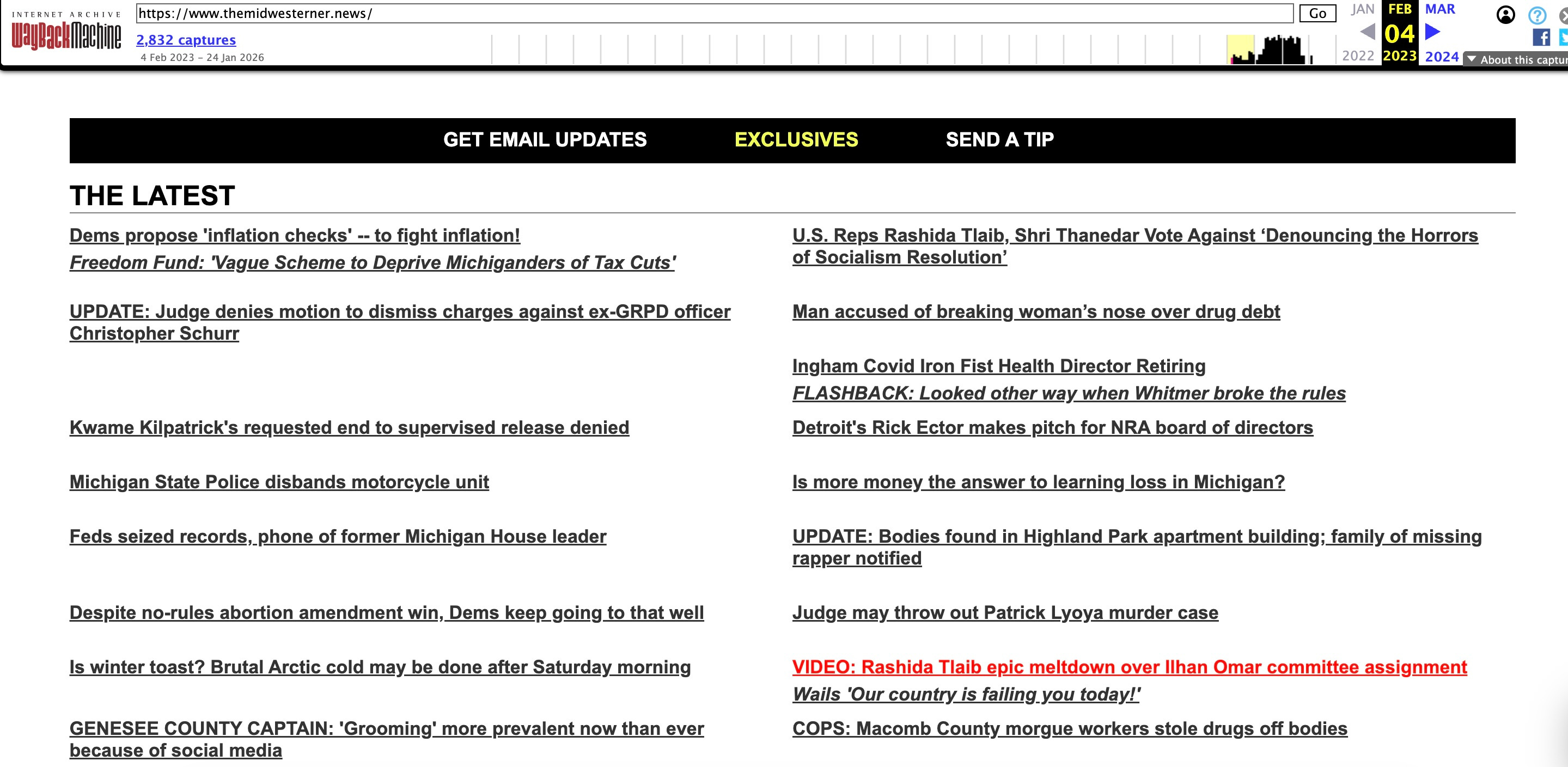
In other words: classic pink slime.
Today, the model has evolved. We’ll get more into that in a future Spin Class. But there’s still no masthead, About section, or way to contact anyone who works there beyond a general info email address. There are still no ads, paywalls, or paid subscription options. Most of the articles are written by “The Midwesterner Staff” and there’s a suspiciously large volume of content across the site, the vast majority of it resembling AI-generated slop. Everything is still hyper-conservative and sensationalist.
It’s still pink slime, just an updated 2026 version.
But I didn’t know any of this when I saw the same tweet quoted in Playbook and the NYT. I just noticed a Michigan news outlet that I, a Michigander, had never heard of, being highlighted by two outlets I regularly read. And I wanted to understand more.
“Who Owns The Midwesterner News?”
I’m not a journalist, I’m just curious. So I simply Googled this question. And this was literally the first hit:
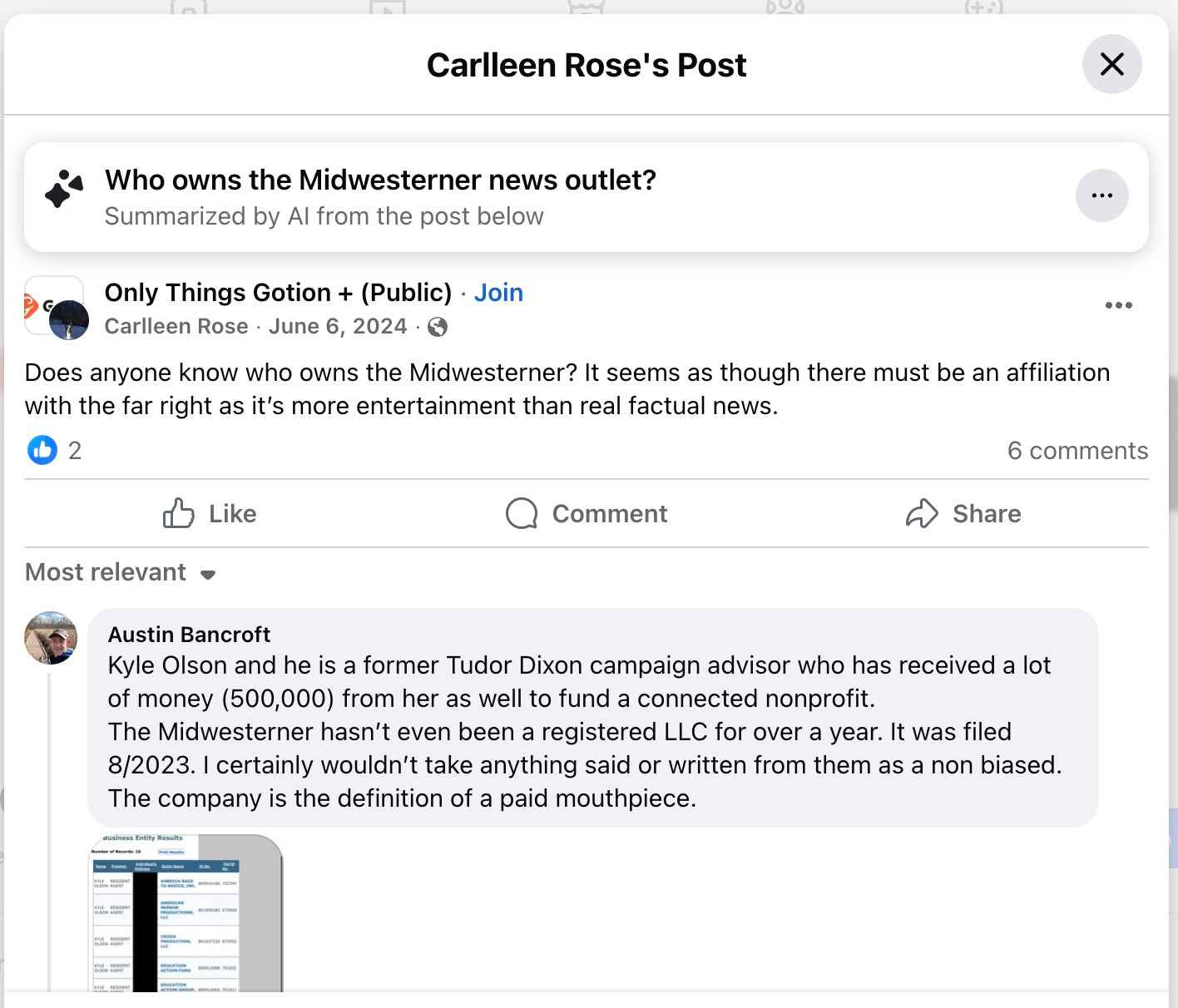
Tudor Dixon, you’ll recall, is the conservative media figure and Republican gubernatorial candidate who lost to Gretchen Whitmer in the 2022 Michigan blue wave. Dixon’s candidacy and that election could be a book unto themselves, including massive primary voter fraud shenanigans and Dixon blasting out her own party’s internal postmortem, which blamed her candidacy for dragging down the state ticket.
But what’s important for our purposes is that the Midwesterner, the pink slime website pumping out anti-Democrat content, was apparently created and owned by a known associate of the Republican candidate who lost to Gretchen Whitmer in 2022? That… seems relevant.
So I kept digging. And struck gold.
Kyle Olson is indeed the founder of the Midwesterner, per his LinkedIn (he’s also a frequent guest on Tudor Dixon’s iHeart podcast). Per Michigan’s Business Registry Portal, Kyle Olson is also the owner of Midwesterner Media, LLC. Interestingly, Midwesterner Media’s Articles of Organization were not filed until August 14, 2023, even though the site seems to have started publishing in February 2023.
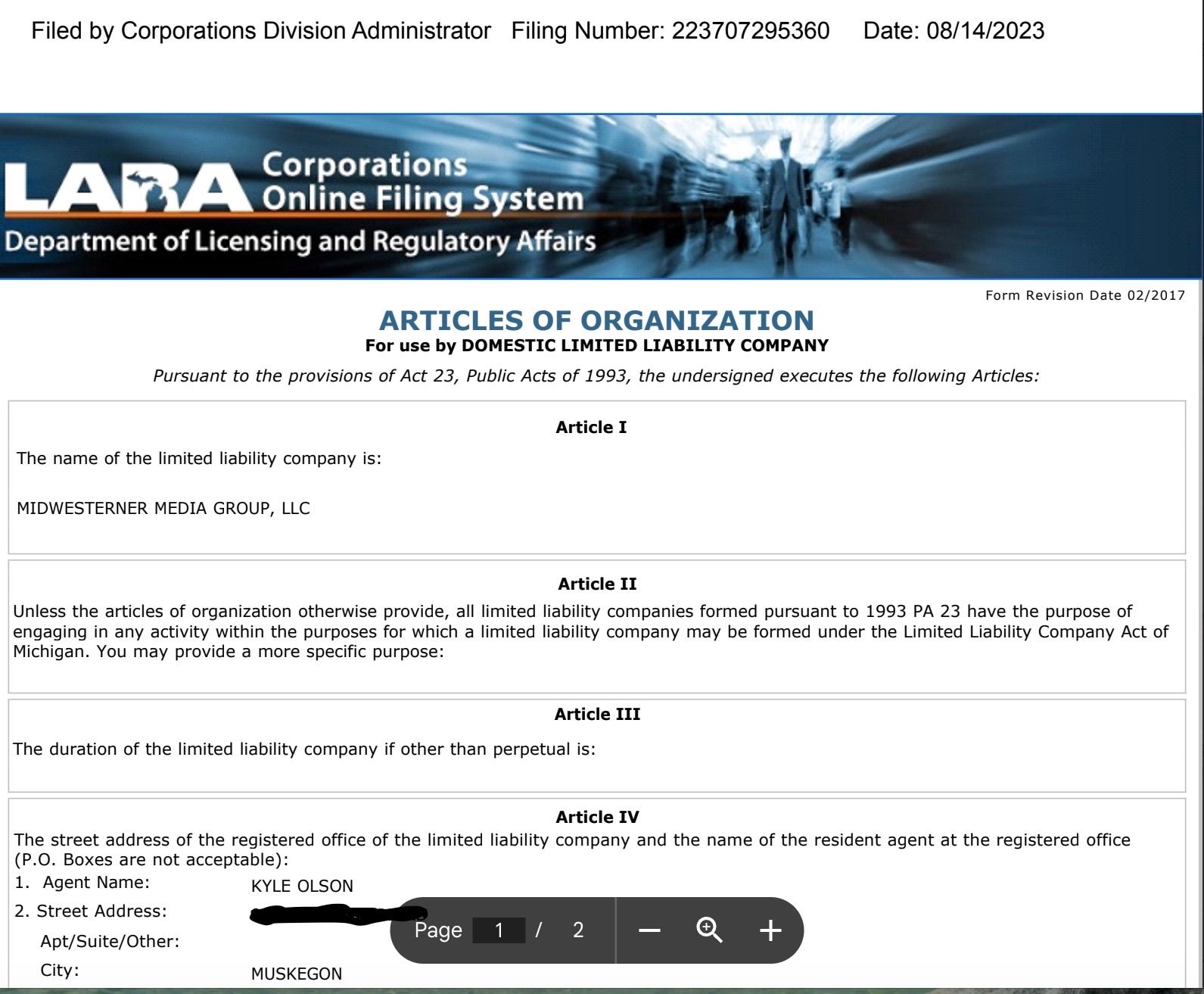
Annual statements with the Michigan Department of Licensing and Regulatory Affairs for 2024 and 2025 continue to show Kyle Olson as the owner of Midwestern Media Group, LLC.
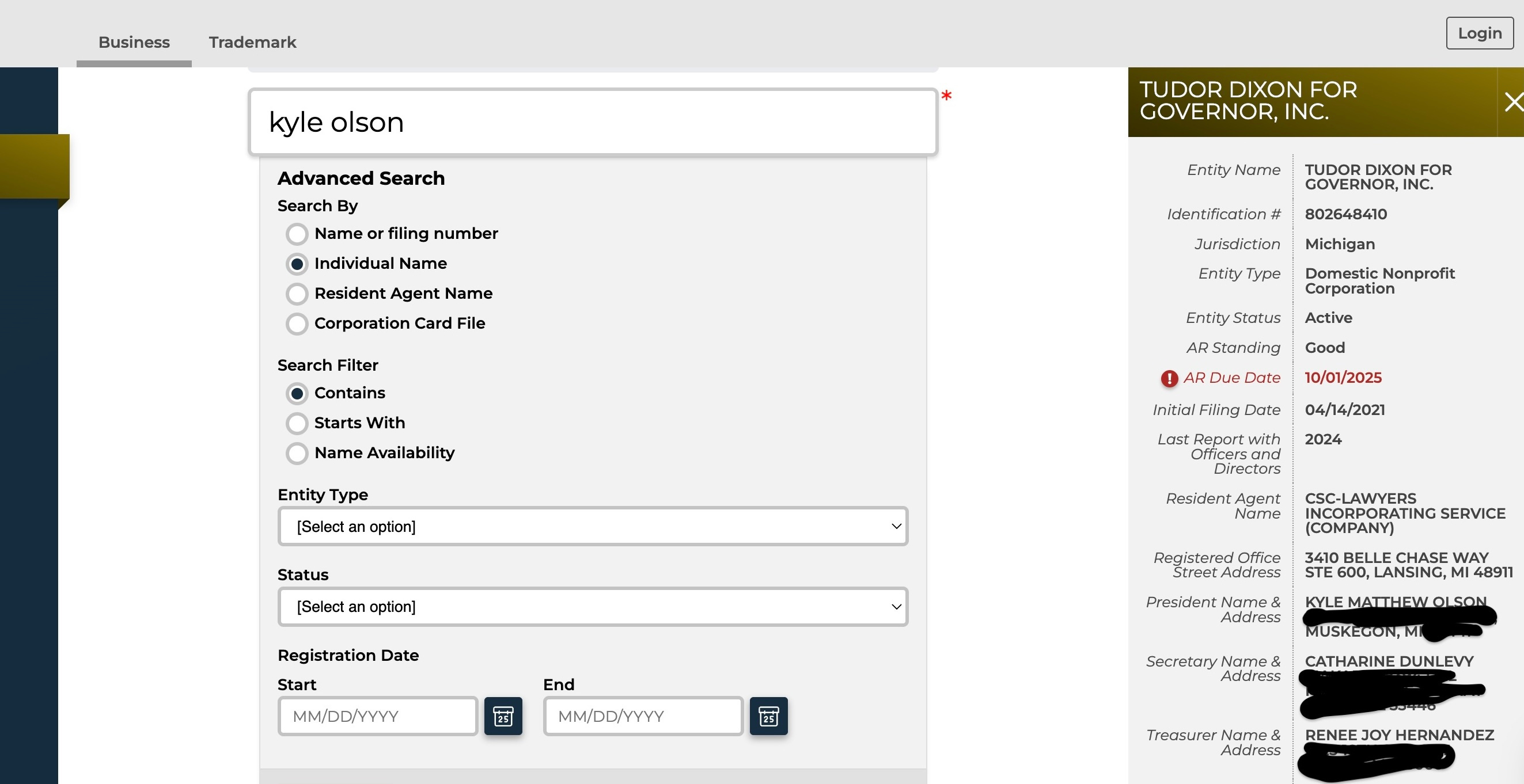
And a further search shows a Kyle Olson (same address) is also listed as the President of Tudor Dixon for Governor, Inc.
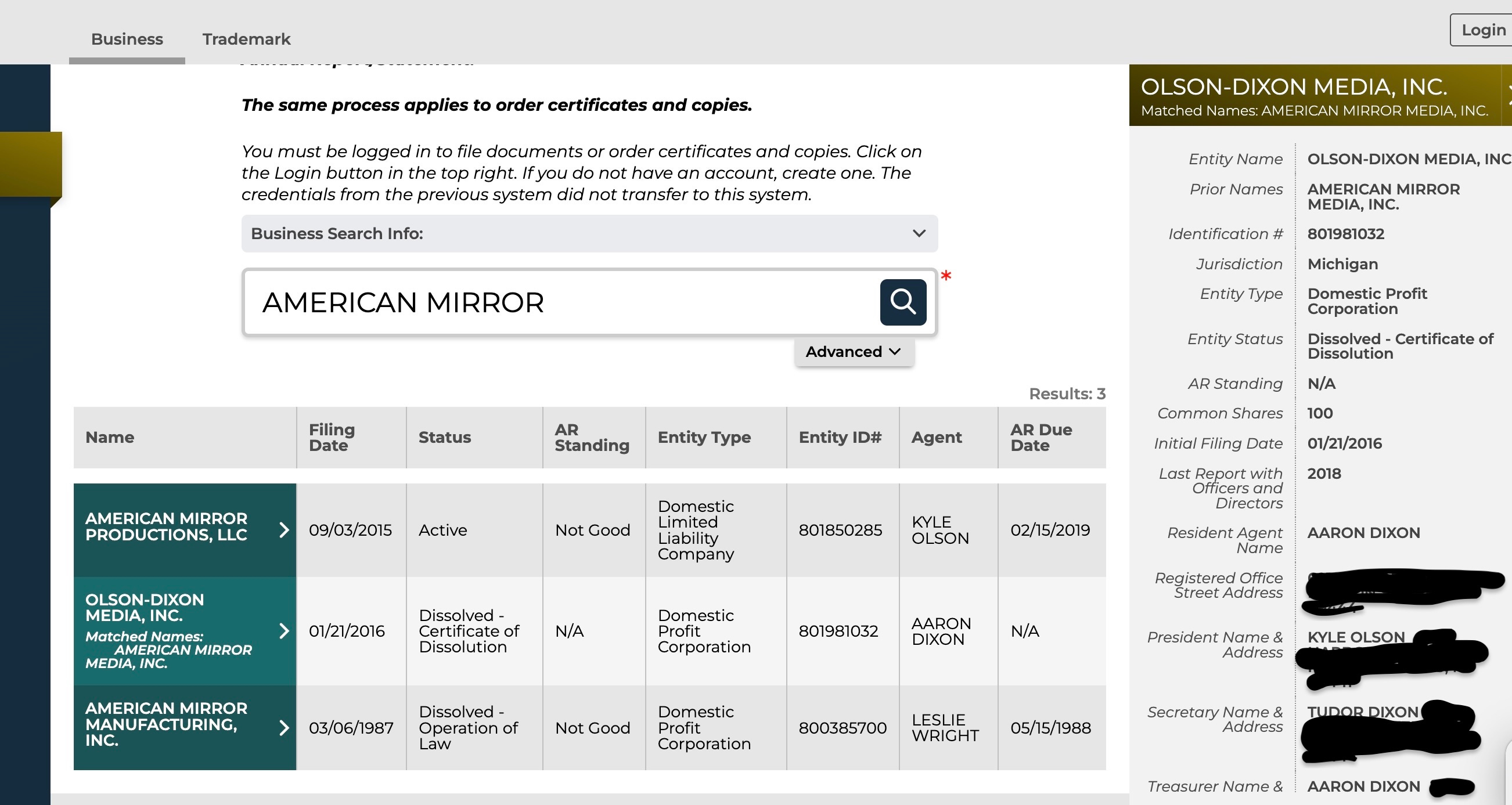
It keeps going: Kyle Olson also owned an LLC called American Mirror Media Inc., which was incorporated in Michigan on January 21, 2016. On June 14, 2017, American Mirror Media, Inc. filed paperwork to change its name to Olson-Dixon Media, Inc. The next week, it filed paperwork to add Aaron Dixon, Tudor Dixon’s husband, as a registered agent for Olson-Dixon Media, Inc. All this is documented in publicly available paperwork on file with the Michigan Department of Licensing and Regulatory Affairs, which I won’t link directly to here as it includes too many addresses to black out.
Olson-Dixon Media, Inc. was dissolved in May 2021 on the day Dixon entered the Michigan gubernatorial race. When it was dissolved, Kyle Olson, Tudor Dixon, and Aaron Dixon were listed as its officers.
So let’s recap: The owner of the Midwesterner, which publishes reams of anti-Democrat and anti-Whitmer content (much of it likely AI-generated), is literally the president of her Republican challenger’s campaign. And they went into business together with Dixon’s husband nearly a decade ago, long before Dixon ran for office.
To state the obvious: 🚩 🚩 🚩.
None of this is being disclosed where it’s easily accessible. It all raises many, many more questions about what work they did together, how they got paid, who paid them, the eight other LLCs affiliated with Kyle Olson in Michigan, and what ties they may have to Tudor Dixon, other Republican figures, and beyond.
There’s a lot more I’ve found in just a day of research about how the Midwesterner is run, who “writes” for it, and the networks with which it’s associated. I couldn’t possibly get it all here, but for now, feel confident asserting that this is a partisan pink slime site, connected with several right-wing content farms and dark money groups that are known pink slimers, and it has unexplained links to similar pink slime sites in at least two other Midwestern states. I’ve spoken with contacts in Michigan who are familiar with how The Midwesterner operates, and they agree with these assessments.
But we’ll set that aside for now. The main takeaway here: it’s clear that the Midwesterner isn’t a real media outlet, it’s a right-wing political content mill—which the New York Times and POLITICO both failed to note when they cited its viral tweet as the kind of foreign policy criticism that Democrats just need to face.
The leading political news outlets of our time should not be sourcing their reporting from scammy, obviously partisan websites with no mastheads. They shouldn’t be linking to their content without explaining who it’s from and what it’s about. But it appears they either didn’t know what they were citing, or didn’t care to find out.
Before we go deeper into pink slime and this particular manufactured narrative, let’s take a second to talk Taiwan policy.
AOC’s answer on Taiwan was 20 seconds extracted from an hour-long event at which she spoke eloquently and forcefully about a range of foreign policy issues. It’s also true that her answer could have been better phrased. It’s certainly not the clunky yet precise script that decades of U.S. government officials have all used when asked any question about Taiwan, terrified of flubbing a single word and inadvertently triggering a slew of headlines and angry demarches.2
Watching her answer, I see someone trying not to bumble a complicated answer that she knows is always delivered with extreme precision, and not totally sticking the landing.3 But substantively, it’s a layperson’s echo of the basic points of strategic ambiguity, which has been official U.S. policy towards Taiwan for AOC’s entire life: you don’t directly answer the hypothetical of whether the U.S. would militarily support Taiwan in an invasion, and pivot back to the need to prevent such a scenario and maintain the status quo.
So no, her language isn’t perfect. But the best misinformation contains a nugget of truth.
Also, if refusing to give a clear statement on Taiwan policy was a political disqualifier, the entire Trump administration would be out. There’s zero mention of Taiwan in Trump’s National Defense Strategy, departing from longstanding bipartisan language (including his first administration). Trump is reportedly considering discussing U.S. military support to Taiwan with China, which would directly violate the Reagan-era agreement undergirding the U.S.-Taiwan relationship called the Six Assurances. And a few weeks ago, Trump said that Xi Jinping should decide what happens to Taiwan:
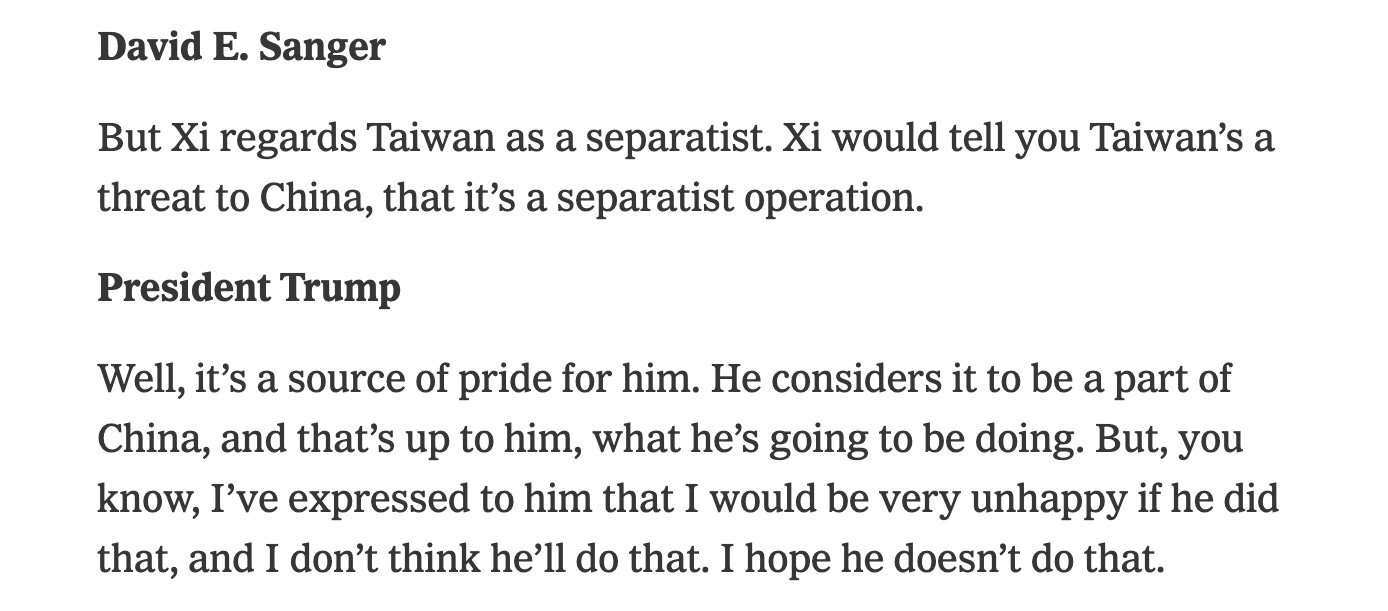
But no, the young woman politician who didn’t perfectly deliver the answer but still reflected what U.S. policy has been her whole life is the real problem.
How a Fake News Narrative Gets Laundered
The level of vitriol, much of it overtly sexist and ageist, that AOC’s Taiwan answer generated in mainstream media was overwhelming. But it was also delayed. Why?
Whitmer and AOC’s foreign policy panel at Munich was at 10pm local time, Friday, February 13 (late afternoon EST). But the Wall Street Journal and the Washington Post didn’t publish their highly critical editorials until three days later, Monday, February 16. Why?
The Munich Security Conference is absolutely crawling with reporters looking to break news. If AOC and Whitmer’s comments were newsworthy, they would have been covered as such in real time. But they weren’t.
What did happen - at least what’s visible with open source research - is that coordinated networks got busy, and conservative media figures dutifully shifted the narrative. Without Twitter API access, it’s hard to map exactly what happened, but the Midwesterner tweet clipping the video and mocking both Whitmer and AOC appeared the morning of February 14 and almost immediately started getting unusually high traffic. It quickly racked up over 10,000 likes (other recent Midwesterner tweets average around 100). It was quickly picked up and amplified by prominent professional cranks like Glenn Greenwald and Ian Miller. But it was also amplified by more Sunday show-friendly conservative voices like Mary Katharine Ham and Matt Whitlock.4
That’s a crucial step: for something to go viral enough to jump from pink slime to getting featured in the New York Times as received wisdom, it has to be laundered through voices that are coded more palatable than your average blue-checkmarked MAGA troll with an American flag in the bio. Volume alone, without more credible voices amplifying, can actually be detrimental - if it’s too obviously trolly and pushed by bots, savvy audiences can smell something is off.
To be clear, I’m not saying this one tweet was solely responsible for this narrative accelerating and breaking through. That’s not how this works. What’s far more typical is that slop pushers throw a lot of different content up on social media, closely watch its performance, and double down on whatever gets traction.
For example, before the Midwesterner post went viral, there was a nearly identical tweet Friday from a MAGA foreign policy content shop called Polaris National Security. Despite getting amplified by power users like Jonah Goldberg, this one didn’t take off like the Midwesterner tweet eventually did. But it shows how there were multiple attempts shortly after the event to push out the same message. All it takes is one spark catching.
At some point over President’s Day weekend, the chatter on right-wing social media got loud enough to reach mainstream conservative political journalists. The Washington Post either commissioned or accepted a pitched op-ed from National Review senior political editor Jim Geraghty, which ran Monday morning. Geraghty’s op-ed does not mention the viral pushing of this narrative in right-wing media circles, note any of the second Trump administration’s inconsistencies on Taiwan policy (to be fair, he later did a separate piece on those), or contextualize how AOC’s answer substantively mirrors longstanding U.S. policy. The Wall Street Journal editorial, which also ran Monday morning, also fails to mention any of these points. And other conservative media outlets like Breitbart, the Washington Examiner, the Daily Caller, and many more start pushing out a new wave of stories that reflect and amplify the narrative seeded on social media over the weekend.
This is important: The tone of Monday and Tuesday’s coverage of the AOC/Whitmer event is markedly different from how journalists actually on the ground in Munich covered it in real time— including conservative outlets. For example, Washington Examiner White House reporter Mabinty Quarshie covered the AOC panel the day it happened and did not mention the Taiwan answer in her (reasonably fair and accurate) story:
Rep. Alexandria Ocasio-Cortez arrived at the Munich Security Conference on Friday to deliver a “working-class perspective” on foreign policy. But on the world stage, the New York Democrat offered a message far more familiar to global elites: expand social welfare programs and rely on global alliances to combat authoritarianism.
…
“In a so-called rules-based order, the rules for whom? Because for all too long, the rules only apply to the United States, Europe, its allies, and we would carve out exceptions for the Global South,” Ocasio-Cortez said during a panel on foreign policy that included Gov. Gretchen Whitmer (D-MI). “And I think that when you have a rules-based order where you carve out exceptions to our values, exceptions to our rules, eventually the exceptions become the rules.”
But shortly afterwards, the Examiner started publishing op-eds and “news analysis” pieces from people who weren’t actually in Munich, but were nonetheless eager to parrot the emerging right-wing social media narrative about her Taiwan answer. I count at least seven separate Examiner stories as of the morning of February 19 echoing those themes. None of these stories link back to the Examiner’s own reporting from Munich.
POLITICO, whose Europe team covered the AOC/Whitmer event live, quoted this from the AOC panel: “We are shocked at the president’s destruction of our relationship with our European allies. His threatening over Greenland is not a joke. It’s not funny. It threatens the very trust and relationships that allow peace to persist.” The NYT liveblog didn’t cover this event, but did write about AOC’s separate press conference with Jason Crow. Neither liveblog mentioned her Taiwan comment specifically, nor criticized her comments generally.
Instead, reporters actually in Munich focused on Rubio’s “Diet Vance” speech and whether Europeans found reassurance there (mostly not), Lindsay Graham’s expletive-filled comments about Greenland, Zelensky’s appearance, revelations on how Russia killed Alexei Navalny, and other European defense and security issues. If they wrote about AOC and Whitmer from the ground, it was generally short and fairly neutral pieces that largely overlooked AOC’s Taiwan answer and instead focused on her comments on populism, inequality, and authoritarianism.
Given the different tone from journalists actually in Munich, the delay between the event itself and the first wave of mainstream conservative op-eds, and how closely that wave mirrors the social media messaging (minus some of the more overt sexism and abusive language), it’s pretty clear: the weekend flood of negative right-wing social media dramatically shifted the narrative as conservative news voices picked up the new framing. Their pieces were shaped not by what actually happened in Munich, but how it was sliced, packaged, and pushed by right-wing content trolls on Saturday and Sunday.
By Tuesday, the right-wing narrative is firmly settled into the mainstream. The day is a blur of cable news panels, scoldy thinkpieces, and pile-ons. JD Vance weighs in on Tuesday, calling her comments the “most uncomfortable 20 seconds of television” he’s ever seen.5
And now it’s widely “known” that AOC (and Whitmer) stumbled at Munich. That their so-called failures there indicate they specifically, and Democrats generally, are not to be trusted at foreign policy.
Implicit in that is that we shouldn’t listen to anything else AOC, or Whitmer, said at Munich — certainly not AOC’s warnings that governments that fail to provide for their people or take steps to check increasing inequality are at greater risk of sliding into authoritarianism. That right-wing forces around the world are working together to accelerate those dynamics. That AI supercharges all of this.
The harder the trolls come for a messenger, the more afraid they are of their message. There are powerful forces that fear what AOC said at Munich. She’s contesting the populist message they’ve sought to dominate by focusing on the elites who benefit from rising inequality, and that can’t be allowed to gain traction. So they throw everything they have at tearing her down, attacking her for how she’s saying things to drown out what she’s actually saying.
And that’s how a tweet from a sketchy right-wing pink slime website gets laundered into conventional political wisdom.
This case study shows why pink slime factories and other dark media sites are so dangerous: they have the veneer of legitimacy and respectability, and can easily slip into our media diets unnoticed. In a saturated, hyperpartisan, AI-supercharged media environment, we’re all trying to make sense of who and what we can trust. So we look for shortcuts, like what the sources we already trust are serving us.
When outlets like the New York Times and POLITICO cite sources, they’re inherently vouching for those sources’ credibility. They’re lending them their own accumulated trust and gravitas. The NYT has done phenomenal reporting on pink slime and other digital media scams, which is part of why seeing them casually cite pink slime as if it were actual journalism is such a massive disappointment.
But the sheer volume of right-wing pink slime out there, the pressures of deadlines, clicks, and scoops, and U.S. political journalism’s performance of the quest for balance all make mistakes like these more likely. So does the blurring of reporting and analysis that regularly frames political news not around what actually happened, but how political actors are framing what happened.
I realize the irony here. After all, that’s exactly what I’m doing with Spin Class: trying to explore how information sausage gets made, and why it matters. But what we’re doing here is fundamentally different than beat journalism, which we all still need. Journalists report the news, not analyze it. I’m not a reporter. I’m a former government spokesperson with experience in how disinformation networks operate and above-average research skills. And I’m honest about that.
But if I could suss out in a few Google searches that the Midwesterner is a conservative pink slime site owned by the political enemies of the people it regularly attacks, then I’d expect the New York Times and POLITICO to figure that out before treating them as a legitimate source.
And if the NYT and POLITICO hadn’t been so eager to write the cheap political framing story, maybe they wouldn’t have missed the real story: how all these political journalists failed to notice the vast, coordinated effort to reshape the “AOC at Munich” narrative, hiding in plain sight.
While writing this newsletter, I emailed the bylined reporters for both the NYT and POLITICO stories to ask if their outlets have editorial standards for citing known or suspected pink slime websites, and whether those standards were met here. I also asked them how they found the Midwesterner’s tweet, and whether/how it was vetted to ensure it met their editorial standards.
Neither outlet responded.
Huge thanks to the American Sunlight Project for help with research. Lots more to come in a future edition, including a deeper dive into these pink slime websites and the networks that back them. If you’d like to support this effort, please consider becoming a paid Spin Class subscriber for less than $5/month.
There’s some new research exploring how much conservative pink slime actually impacts electoral outcomes, which merits further study. But the paper trail couldn’t be clearer: pink slime is overwhelmingly set up, funded, and pushed by conservative dark money groups.
“The United States approach to Taiwan has remained consistent across decades and administrations. The United States has a longstanding one-China policy, which is guided by the Taiwan Relations Act, the three U.S.-China Joint Communiques, and the Six Assurances.
We oppose any unilateral changes to the status quo from either side; we do not support Taiwan independence; and we expect cross-Strait differences to be resolved by peaceful means.
We continue to have an abiding interest in peace and stability across the Taiwan Strait.
IF ASKED ONLY: Consistent with the Taiwan Relations Act, the United States makes available defense articles and services as necessary to enable Taiwan to maintain a sufficient self-defense capability -– and maintains our capacity to resist any resort to force or other forms of coercion that would jeopardize the security, or the social or economic system, of Taiwan.” I will be able to recite this on my deathbed.
When I covered the East Asia portfolio for NSC Press at the end of the Obama Administration, a colleague confided he kept the standing Taiwan language on a laminated card in his wallet in case he was ever asked about Taiwan in any public setting. That gives you a sense of how sacrosanct and carefully calibrated this language has been, across administrations, for a very long time.
It’s actually this, and I suspect he secretly agrees.
Literally felt like I was losing my mind or being gaslit by the media. I watched both of her events live & thought she did extremely well. Then, the media told me I should ignore my own eyes and ears and trust them when they said she committed gaffes and embarrassed herself. Insanity. Thank you for this article.
Thank you! I had not heard this term until your article today, and I've been in journalism in one capacity or another for decades. How embarrassing! :-D Thank you so much for spreading the word.