
Trump's Inner Circle Doesn't Support His Iran War
What the conflicting messages, awkward silences, and calculated leaks reveal

Reporters have to cover what government officials say and do. It’s much trickier to cover what officials don’t say and do that they would normally do when, say, starting a war. That particular problem has long plagued how the Washington press corps covers Iran hawk thinking (magical thinking and Underpants Gnomes foreign policy abound).

But now that the hawks got their wish and Trump has started his war with Iran, it’s worth exploring how the messy, awkward, and frankly weird comms around its rollout deviated from the normal ways that a normal Presidential administration would explain to the American people why we’re going to war, what success looks like, and what we can all expect.
You likely missed it, but in the flurry of reporting over the weekend about how Trump decided to (illegally, without even the pretense of a justification) attack Iran, there’s a big story buried in the subtext: much of Trump’s own inner circle doesn’t support his Iran war.
Or, at the very least, they think it will end badly and are trying to protect themselves from the fallout.
Exhibit A: Immediate CYA in Mainstream Political Press
Less than 12 hours after the bombs started dropping, key members of the Trump national security team were making clear in The Atlantic that they tried to dissuade Trump from attacking Iran:
In the days leading up to the attacks, some of Trump’s most senior advisers, including Vice President Vance, Chairman of the Joint Chiefs of Staff General Dan Caine, and the senior Pentagon official Elbridge Colby, expressed reservations about the operation. Caine in particular was unsure as to whether air strikes alone would be enough to undermine the regime, and he privately warned about how complicated any move against Iran would be, according to two U.S. officials who were among those who spoke with us, on the condition of anonymity, about Trump’s decision making and the debates within the administration.
This is Washington-Speak for I SWEAR I THOUGHT THIS WAS A TERRIBLE IDEA DON’T BLAME ME.
But wait, there’s more!
Trump’s chief of staff, Susie Wiles, the architect of his political comeback in 2024, did not offer a personal position on the wisdom of the strikes, according to a person familiar with the conversations. But in an effort to make sure the president was fully informed, she did present him with concerns about the unpredictable consequences of an attack. She also organized a conversation about the importance of following through on the promises he’d made during his presidential campaign about avoiding new foreign wars. Republican midterm strategists, many of whom gathered in Florida for meetings this weekend, have grown anxious about Trump’s foreign military adventures turning off voters who want their leaders to focus on the economy.
As we’ve talked about before, if Susie Wiles’ personal opinion makes it into mainstream press 99% of the time it’s an authorized leak. This reads to me like a message from Wiles to Republican powerbrokers that she is mindful of their concerns about the economy, cost of living, and not starting foreign wars that will be at the forefront of midterm voters’ minds. The subtext: I, Susie Wiles, haven’t forgotten what really matters. Just let me manage this episode, and we’ll get back on track.
This Atlantic article understandably got buried in the flurry of reporting on Saturday, but it really bears footstomping: literally the same day that Trump started this war, his Vice President, Chief of Staff, Pentagon policy lead, and Chairman of the Joint Chiefs were all trying to distance themselves from it.
Trump court politics require that they all eventually play their parts and publicly support his war, which they’re already doing. But these comments are a signal to their future clients, donors, think tank hosts, and fellow dinner party guests (i.e., people who read The Atlantic): I always thought this was fucked, but nobody could tell him no. What more could I have done?
Exhibit B: Sunday Show No-Show
Trump administration leaders were notably absent from the March 1 Sunday show circuit, more than 24 hours after Trump’s middle-of-the-night speech announcing the start of combat operations. Normally, when an administration has a big policy rollout or is trying to robustly defend itself against a bad PR cycle, it will send its best spokespeople out to make its case on the Sunday show circuit.
The purpose of Sunday shows in 2026 isn’t to drive ratings (which are low), break news (which this administration does on Truth Social and other owned platforms), or to reach their base audiences (who don’t tune in). You go on a Sunday show to set the agenda of what constitutes “normal” or “conventional wisdom” in U.S. politics, and to shape the Overton Window of respectable political conversation. The interviews are usually fairly safe and full of predictable questions.
And it’s not like the White House didn’t have the messengers ready. The White House held a press background briefing on Saturday, which a source familiar told me was headlined by Marco Rubio, Jared Kushner, and Steve Witkoff. So, if you’re the White House and you feel confident having these three officials speaking on background with the entire Washington press corps, then why not put them on the Sunday shows to make the case directly?
Answer: because those men didn’t want to defend this war on camera just then, and figured out a way to squirm out of it.
Exhibit C: Muted, Conflicting Responses from 2028 Contenders
Both Vance and Rubio understand how unpopular a war with Iran is with key elements of MAGA’s base. Vance is at heart an isolationist, and Rubio is a WestHem guy. As they both position themselves for 2028, neither of them wants to spend down political capital on an open-ended conflict with Iran, particularly when it’s likely to spiral in all sorts of unpredictable ways.
Days after operations against Iran started, Vance and Rubio’s X feeds have virtually no original content on Iran operations. Neither of them posted anything celebrating the death of Ayatollah Khamenei, as they did for Maduro’s capture (Vance, Rubio). Neither of them has commented on the loss of U.S. servicemembers, or attacks on U.S. military and diplomatic facilities.
When Vance and Rubio both finally did on camera, on-the-record interviews about Iran on Monday, they were not singing from the same sheet of music. Vance insisted to FOX News’ Jesse Waters in a softball interview that the timing was entirely about Iran’s nuclear capability. But earlier that afternoon, Rubio had told reporters at the Capitol that the timing was precipitated by Israel and the purpose was to eliminate Iran’s ballistic missile capability. His topper mentioned nothing about Iran’s potential nuclear capabilities.
These conflicting responses tell us a lot. There’s no agreed-upon military objective. The administration can’t or won’t make a consistent case as to why it attacked Iran now, and what the specific threat to U.S. interests was. And that Trump’s most trusted advisors, the people who any President needs to be honest and forthright with him as he makes consequential national security decisions, are more focused on protecting their own political futures than giving him sound advice.
Exhibit D: Contrasting Messages from the Pentagon
On Sunday someone at the Pentagon briefed Congressional staff that, per CNN:
Iran was not planning to strike US forces or bases in the Middle East unless Israel attacked Iran first, undercutting the administration’s argument Saturday that Tehran was planning to potentially strike the US preemptively and posed an imminent threat…
The briefers pointed to Iran’s ballistic missile program and proxy forces as evidence that they posed a threat to US forces in the region, but sources noted that has been true for years and did not support the administration’s argument that the US needed to attack Iran first.
Spin Class Rule™: If you want something to be public with no fingerprints, brief it to Congress. It’ll get leaked faster than the toilets on an aircraft carrier that hasn’t been allowed to dock for maintenance in eight months.
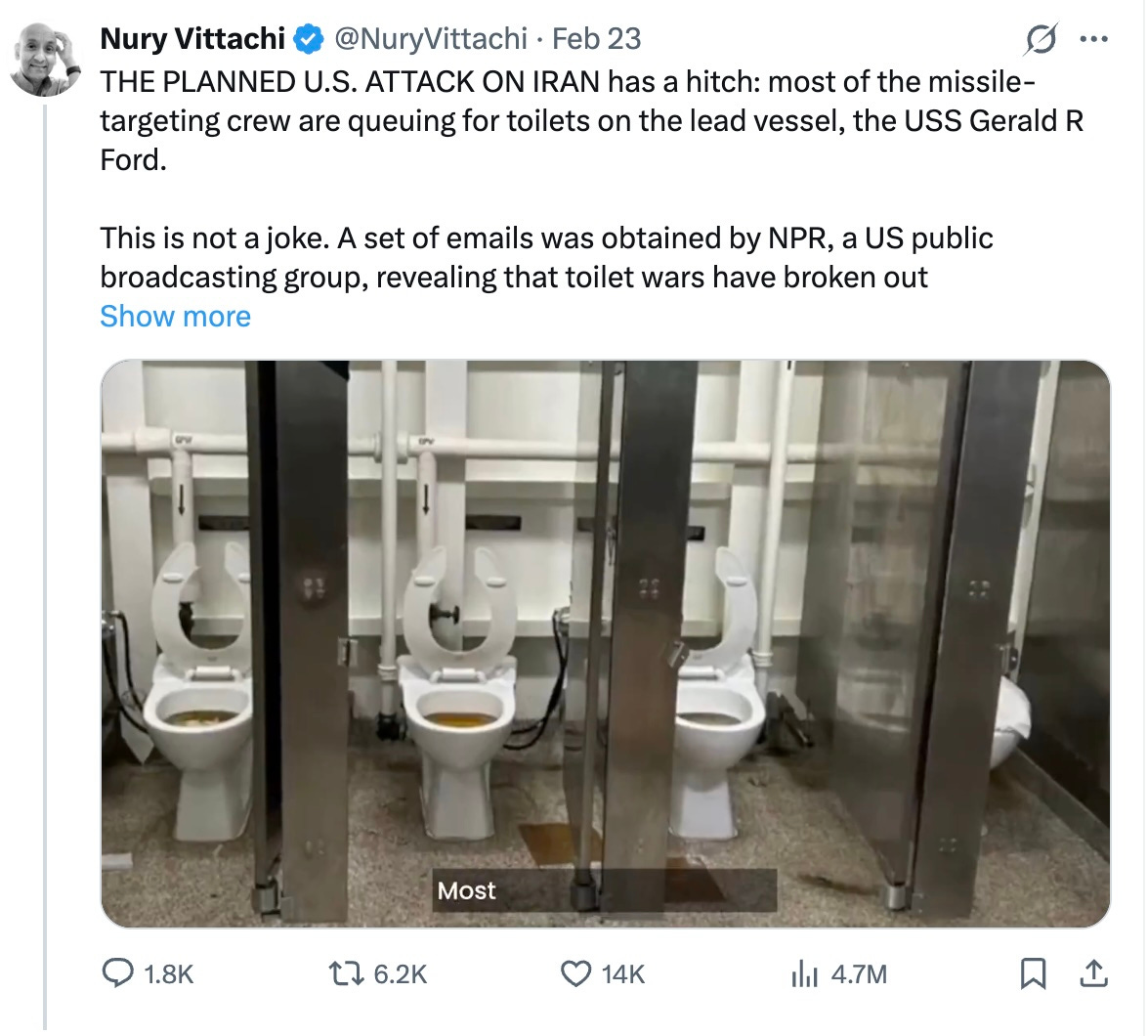
The Hill brief was a clever way for Pentagon officials to get out a contrasting narrative that, they hope, may allow some of them to preserve a shred of dignity or credibility when all this is done. It was only necessary because the second Trump administration has ruthlessly purged dozens of admirals and generals for the supposed crime of disloyalty, or providing an unwelcome response when asked for assessments or advice.
This has created a chilling effect across the Pentagon, where it’s clear: to say no, or to be seen as saying no, will cost you your job. It doesn’t matter if you’ve been trained and invested in for decades, so that you can be ready to give an honest answer when the Commander-in-Chief asks for your best military advice. If anything, that’s likely more of a danger to you.
We should all be terrified that Trump has purged military leadership who can tell him even “this may not work” or “if you do X, then Y may happen.” It means that the only people he’s hearing from as he launches an open-ended war with Iran, without a clear justification, objective, or even a day-after plan, are yes-men and sycophants.
And still, at least some of them, if their Hill briefings are any indication, believe different things than they’re telling the President directly.
Also, just some fun gossip about the Pentagon’s Monday press conference with Hegseth and General Caine: a source familiar told Spin Class that the invite originally went out only to the new school of Pentagon “reporters” on Sunday. The actual Pentagon press corps requested to attend and were initially denied, until 1) the pool refused to send a camera to cover the event unless they joined, and 2) someone at the Pentagon realized that many of the new “reporters” were unable to attend given the late notice, meaning that Hegseth and Caine would be speaking to a mostly empty room.

Speaking of clowns:
Exhibit E: That Mar-a-Lago War Room Photo
Someone in the Trump White House photo office is secretly in the Resistance.
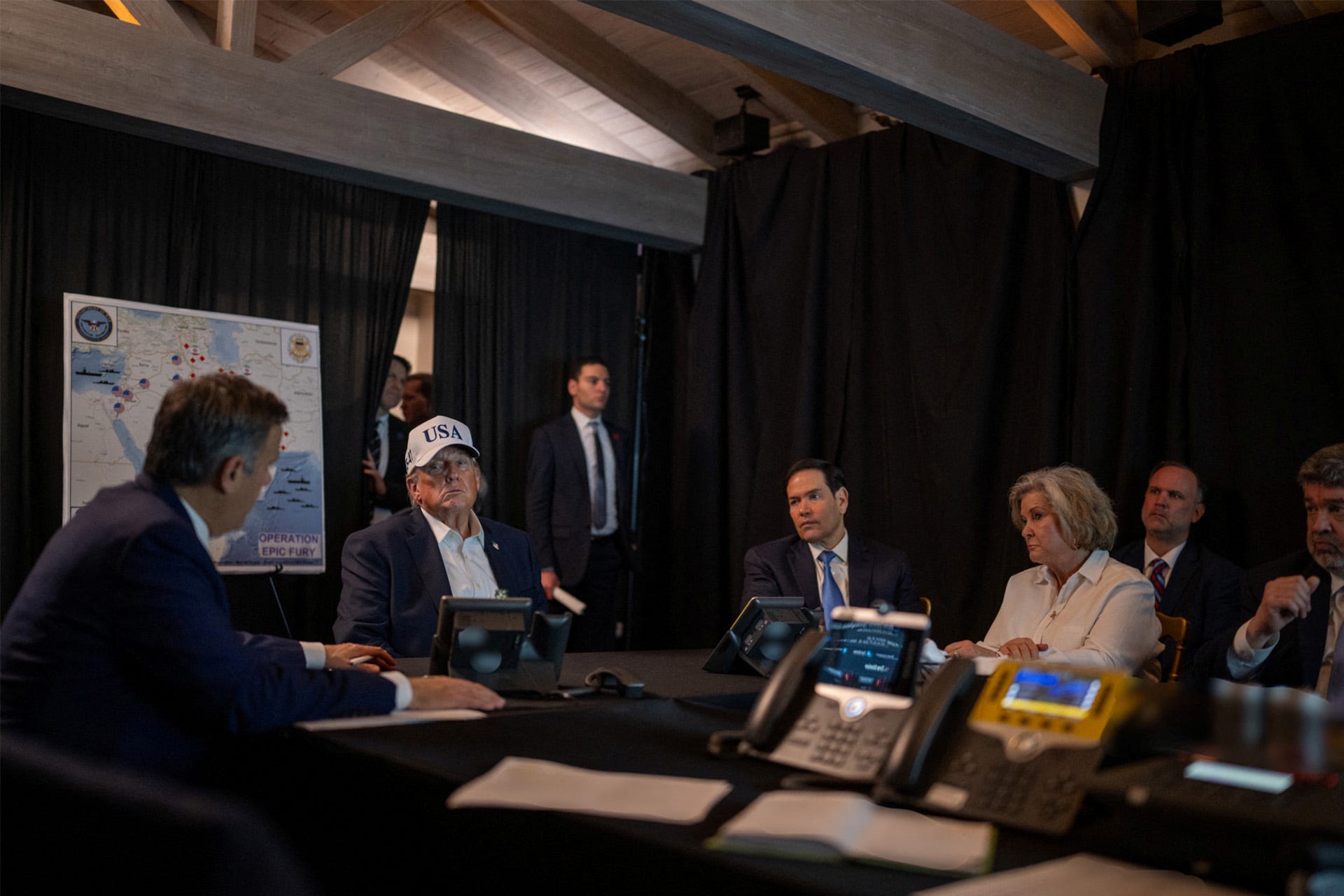
I’m semi-serious here. What other explanation is there for this being the official White House photograph documenting the start of Trump’s Iran war?
Why blur out the decals on the back of the phones but not the map of U.S. military assets? Why not crop it to hide the open top, conveniently letting any of the foreign intelligence assets who surely comprise every Mar-a-Lago staff position overhear real-time decision-making from the Commander-in-Chief? Why highlight the open drapes, with someone peeking in as if asking the attendant to retrieve a jacket from coat check? Good Lord.
I won’t even say anything about his makeup, because it’s not kind to be mean about sick old men.
Predictably, Trump is getting absolutely roasted for yet again conducting such sensitive national security operations from an unclassified soft target. Mar-a-Lago is so vulnerable that an armed lone gunman was able to break into its secure perimeter less than a week before Trump launched a war on Iran from his SCIF blanket fort.
Joking aside, this photo actually represents something important to understand about Trump’s inner circle. He clearly thought this photo was badass, and so his team released it. Yet another indicator that he has systematically weeded out anyone capable of telling him “that’s not a good idea.” Instead, Trump is surrounded by people who can’t or won’t tell him things he doesn’t want to hear. They will publicly defend things that they privately worry about. They will lie to all of us in order to protect their jobs from his wrath.
Look, every spokesperson, myself included, has had to go out and sell things we personally had doubts about. The difference is that in a normal administration, the inner circle typically has the opportunity to debate a course of action before the President decides what to do. When I was in the White House, I could go out and defend hard things publicly because I’d been part of good-faith debates among a team that didn’t always agree but shared a common purpose: bring the President stress-tested options that clearly outline the costs and risks for any proposed action.
That’s clearly not happening in Trump 2: it’s his way, or the highway. Which means he may not be getting relevant information, because people fear the professional consequences of delivering it to him.
That’s hard for journalists to cover, but important for audiences to understand. By reading the subtext of what’s not being said, what’s not being done, and how official spin contrasts with the undercurrent of ass-covering and conflicting narratives floating around Washington this week, we can see more clearly: there is no plan. There is no justification. There are only Trump’s whims, and the fallout that may hit the rest of us.
What I’m watching for next, after the paywall:
