
Spin Class Interview: What We're Not Talking About When We Talk About Venezuela
"Every story should start with an all-caps disclaimer to put into context how bonkers this is."

I struggled with what to write about Trump, Maduro, Venezuela. Even basic descriptive words of what actually happened in Caracas in the early morning of January 3, 2026 - “capture,” “arrest,” “kidnapping,” “secret military operation,” - are loaded. I didn’t want to casually deploy an unsubstantiated take or frame when there’s still so, so much we don’t know and don’t understand. Why now. Why at all. What actually happened, and what could happen next.
Sometimes it feels right to let things settle a bit before getting the hot takes out. Especially when it concerns a subject where I’m less knowledgable than I’d like to be.1
So I reached out to my friend and former colleague Emily Mendrala to help make sense of what’s unfolding in Venezuela, Washington, and across Latin America. Emily is one of the smartest people in DC on Latin America and U.S. national security issues, and our conversation helped me make sense of something I’d been trying to articulate: that part of the reason this has so hard for me to wrap my head around is the fact that it’s all INSANE. As she says below:
The United States just invaded a foreign government and flew its leader (illegitimately governing though he may have been) out of the country to stand trial in the U.S. WITH NO CLEAR PLAN FOR WHAT COMES NEXT!
Bless you, Emily. Thank you for saying this so clearly and directly.
Look: it’s not exactly a relief to have one of the country’s leading experts on U.S. Western Hemisphere policy affirm that yeah, this is bad and you’re right to be worried. But for us former Navy types, still learning to trust our our guts and stop waiting for the people ostensibly in charge to act like we think leaders should act… well, it’s perversely reassuring to hear measured, serious, smart people affirm in plain English that the emperor is in fact strolling around buck naked. That as bad as this is, at least our instincts there are basically correct.

Emily Mendrala is a Senior Advisor of Dinámica Americas, and served as Deputy Assistant to the President, Senior Advisor on Migration, and White House Coordinator for the Southwest Border. Before joining the White House, she was Deputy Assistant Secretary of State in the Bureau of Western Hemisphere Affairs. Emily has also worked on legislative affairs at the National Security Council and as a Professional Staff Member on the Senate Foreign Relations Committee. Outside of government, she has deep experience in non-profit leadership, serving as the Executive Director for Center for Democracy in the Americas from 2017 to 2021.
We’re several days into the aftermath of the U.S. raid on Venezuela: what grade would you give US media for how coverage is going so far? Do you think U.S. audiences are fully understanding what happened and why?
They get an A- so far. Good coverage. Sustained. Events have been so totally bananas that it makes for interesting stories. There is considerable media attention on the operation itself, of course. The operation seems to have been very sophisticated and well-executed. CIA assets, safe rooms, helos, plotting, betrayals, body guards, etc. Who doesn’t find that interesting!? Media is also focused on the legal authority the Trump Admin used to conduct the operation, Maduro’s trial, and - to some extent - events in Venezuela.
Bloomberg and the AP have their ears to the ground. POLITICO’s coverage of the skepticism from oil companies about entering an unstable, uncertain market in an incredibly insecure operating environment is very important. NYT is doing a good job of keeping us informed of the play-by-play of Maduro’s trial (three The Daily episodes in a row!), while covering some of the on-the-ground reporting from Venezuela too.
For a split second, U.S. audiences were focused on Latin American affairs. I got outreach from friends across the country who rarely give LatAm a second thought. Americans were captivated by the brazenness of the attack, for sure, but opposed to it - several polls pre-operation showed that.
The American public is concerned that Venezuela would be another forever war and/or a resource suck – and that the Trump team had no clear plan – at a time when Americans are concerned about the economy, health care, and affordability at home.
What’s the biggest thing missing in the Venezuela press coverage you’re seeing? What are we not talking about that we should be talking about?
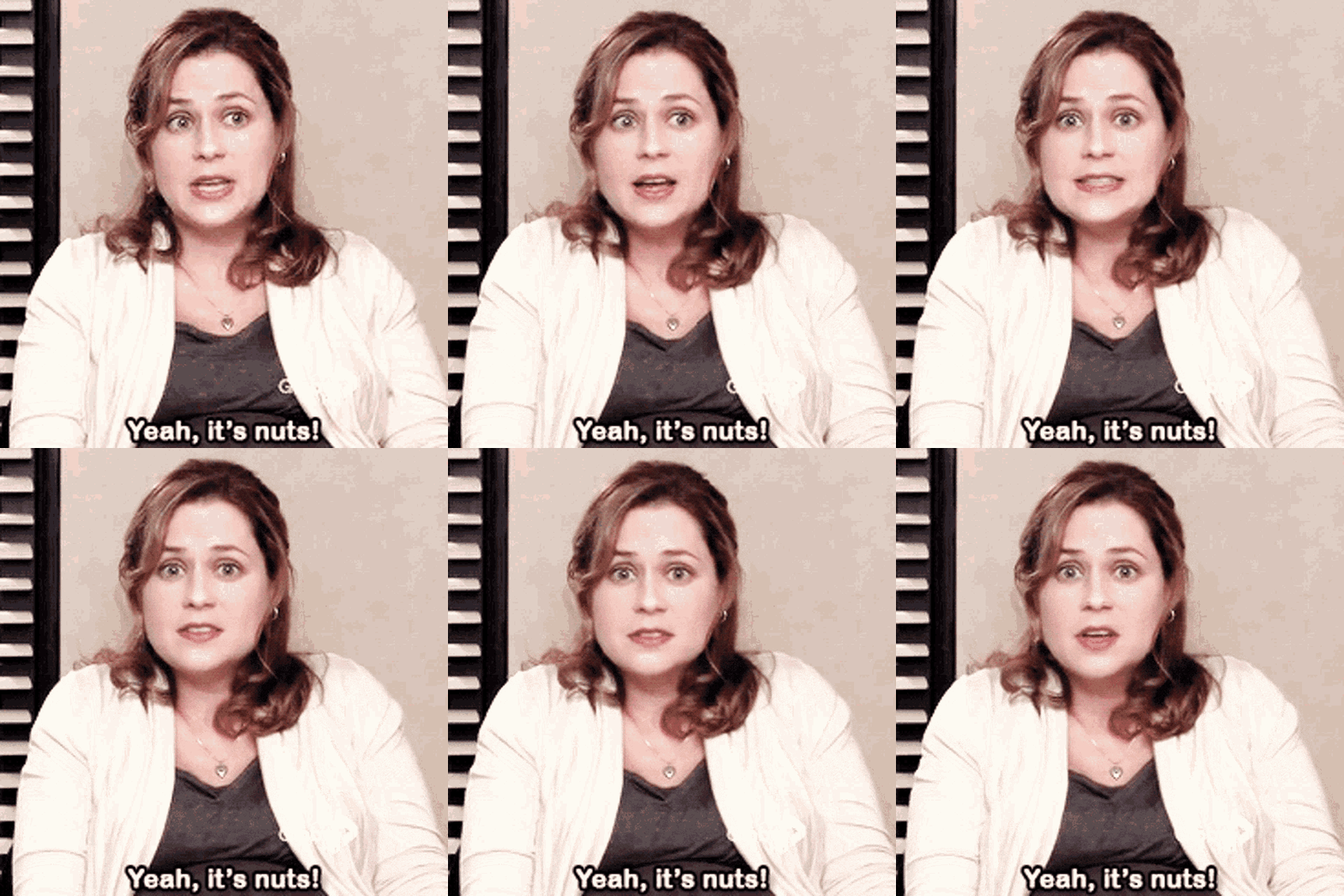
Every story should start with an all-caps disclaimer to put into context how bonkers this is. The United States just invaded a foreign government and flew its leader (illegitimately governing though he may have been) out of the country to stand trial in the U.S. WITH NO CLEAR PLAN FOR WHAT COMES NEXT!
The media should be asking a lot more questions of the Trump Administration, and making clear when they don’t get coherent answers. For example:
What was the Trump Administration rationale for invading? It jumped between drugs, terrorism, migration, and democracy, before settling - pretty clearly - on oil. Is that OK with the American public?
We plan to run the country now, according to Trump. What’s the game plan for governance? What about democracy? Human rights? Political prisoners? (Is anyone talking about political prisoners?) What will this all cost the American taxpayer?
The Justice Department dropped the Cartel de los Soles mention from the indictment? What?!?! Does that mean the Trump administration fabricated an FTO designation to justify invading a foreign government?
Oil companies are scared to go in!2 That seems like a pretty big flaw in the Trump team’s plan. How will they overcome it?
I’m finding myself relying even more than usual on WhatsApp and Signal message groups to try to understand what’s happening in Venezuela and why - in part because the Trump Administration messaging has been all over the place, and also because it’s been nearly impossible for US journalists to report from inside Venezuela recently. What are you seeing in your own group chats that the rest of the world isn’t necessarily getting?
I am a part of several messaging chains with Latin America watchers – some with 30 people and some with ~250 - including policy wonks, journalists, practitioners, former government officials, etc. A quick plug for this version of “community:” these chats are a font of information, good articles, relevant social media posts, etc. The chats surface information before it’s widely reported (reports of a gun fight in front of the presidential palace in Caracas on Monday night, for example). Or social media reports of an intel assessment determining that a Chavismo succession (to former VP Delcy Rodriguez) would provide more stability than installing the democratically elected opposition candidate. This was 24 hours before Bloomberg reported that oil execs made the same case to the Trump administration.
The chats also provide color, a range of perspectives, emotions, and personal experiences that help me better contextualize this moment. For some Venezuelans, this is the first time they have dared to experience hope in decades. That is profound. Some policy experts, on the other hand, are terrified of the precedent Saturday’s actions set, what signals we are sending to countries around the world, and what the next three years of the Trump Administration may bring.
Can you give a quick summary of what’s going on with the Venezuelan opposition? What do you make of Trump’s comments about Machado? Real talk: how much of this is sexism?
Venezuela had an election in 2024. Edmundo González won. A democratic outcome of Saturday’s events would involve Gonzalez and other opposition leaders like Machado. In a major way. It would be complicated, for sure, but the Trump team could have been laying the groundwork for this scenario alongside the operational planning for Saturday’s attack, which was reportedly underway for months before it took place.
I think it’s shameful that Trump hasn’t yet spoken with Maria Corina Machado. Trump’s statements about Machado not having support are baloney. She is beloved in Venezuela and around the world. The woman is fearless.
Real talk: Trump may have felt that a shift to opposition control (vs. deputizing Delcy Rodriguez to lead in Maduro’s absence) after Saturday’s operation would be messy and would require A LOT of U.S. support in the vein of boots on the ground, resources, etc. Trump may also feel like he has a better shot of controlling oil revenues under Delcy than he would under Machado.
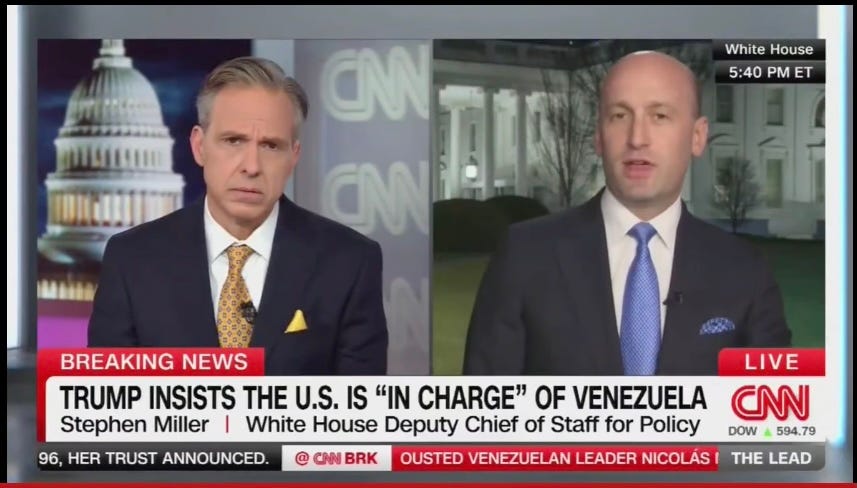
As a Western Hemisphere expert, what did you make of Stephen Miller’s assertion on CNN that “The United States is using its military to secure our interests unapologetically in our hemisphere… We’re a superpower and under President Trump we are going to conduct ourselves as a superpower. It is absurd that we would allow a nation in our backyard to become the supplier of resources to our adversaries but not to us.”
We have become, under this current administration, a bully who issues demands and expects everyone to bend to our will. That strategy has a shelf life, and it’s not long. There’s history, in the Western Hemisphere, of the U.S. unilaterally exerting our will and it doesn’t go well.
The most effective way for us to maintain American influence in the region is to be the best, go-to partner for countries. The Monroe Doctrine, and its Trump Corollary, smashes any notion of partnership. In the not-too-distant future, Trump’s actions will breed chaos and resentment, and will ultimately make the U.S. less safe, undermining our influence for years - likely decades - to come.
How is the rest of the region reacting to Miller’s statement (cough, Cuba)? Are there any differences in how Spanish-language and other local media are covering these comments about US hegemony in the Western Hemisphere versus what we’re getting in US press?
I think the global press is doing a good job of pointing out how extraordinary Saturday’s actions are, while the U.S. press glosses over it - perhaps because it is yet another extraordinary, unprecedented, and legally questionable action by the Trump Administration of the kind we see regularly.
In the region, there is fear. And it’s widespread: not cabined to certain named countries (Colombia and Cuba), which Trump or his team has suggested the U.S. may invade next, or to certain ideologies or political parties. There’s a recognition that the U.S. is no longer a good actor, and prone to recklessness. The implications can and will be far reaching.
How do you assess the reactions from other regional governments, especially those who are already walking tightropes with the Trump administration (e.g. Brazil, Mexico, Colombia)? Is this a moment for broader Latin American unity? Or more of a fracture moment?
Many governments around the world, not just in Latin America, have decided that they will have a greater chance of success if they engage the Trump team bilaterally while they - quietly, on the side - shore up as much of a backup plan as possible with other partners. I have wondered if there is a tipping point, after which that strategy proves untenable and countries choose instead a unified opposition to U.S. overreach. Perhaps this is it, but I’m doubtful.
How does the phrase “the Donroe Doctrine” sit with you? I’m of two minds: on the one hand, it’s deeply stupid and I feel gross even saying it (similar vibes to “One Big Beautiful Bill”). On the other hand: Let Them. No one can perfectly predict the future, but the prospect of indefinite U.S. military presence in Venezuela to secure access to oil (which requires at least $53 billion over the next 15 years to maintain current production levels!) seems like it will age like milk in the Caracas sunlight. So, sure: let them brand and own it.
I’m aligned with your second sentiment. Brand it. Own it. It will fail, like the Monroe Doctrine did decades prior, leaving a nasty legacy. Saturday’s operation was the first test-run of the so-called Donroe Doctrine, and we are already seeing its flaws.
Given where all this is right now, what could success look like in Venezuela? And what’s your personal worst case scenario?
Good question! It’s important to articulate these metrics. For starters, stability. This can be measured by violence and criminality, including drug trafficking; out-migration; provision of and access to government services; etc.
Second, human rights. Will the U.S. demand that Venezuela release its 800-900 political prisoners? Are journalists free to report accurately?
Democracy. What will the political transition look like? Will Venezuela honor the results of its 2024 election? On what timeline? Or will they call for another election? When?
Economic recovery. Will U.S. efforts to rebuild Venezuela’s oil sector bear fruit? And who will benefit from those profits (if/when they come)? Will the process be mired with corruption? U.S. resources. How much will the U.S. invest in these outcomes?
I pray that there are better days ahead for Venezuela. That they come soon and are the start of a bright new chapter. I worry about the many ways that this attempt could go sideways. Venezuela is a tinderbox, and a descent into chaos would bring extreme humanitarian concerns.
Early polling indicates that Americans are split about capturing Maduro, but that 9 in 10 Americans believe Venezuelan people should be the ones determining their future leadership. Thoughts on what explains that split?
Maduro is a bad actor. No one is sad to see him go. Some may celebrate a successful operation in which no American lives were lost. However, Americans are wary of the Trump administration’s assertions that it will “run” Venezuela, presumably at great cost and distraction, when Americans are dealing with economic uncertainty at home.
I also wonder if it reflects that, as Dan Pfeiffer pointed out, Nicolás Maduro isn’t really a known figure in mass American culture like Saddam Hussein, Osama bin Laden, or Muammar Qaddafi were. That lack of cultural resonance makes it harder for Trump to turn general MAGA jingoism into something more Maduro-specific (though they’re certainly trying).
You’re probably right that Maduro lacks cultural resonance across the country (but his tyranny looms very large for certain diaspora communities). It’s also worth noting the schisms in the MAGA movement and the Republican party between those who support foreign engagement (or, in this case, intervention) vs. isolationists.
To that end, some Republicans in Congress are irked at the President’s dismissive remarks about Machado, who they revere, as well as his fixation on oil revenues, with no mention of democracy.
You and I are both Elder Millennials in national security. Our early careers were profoundly shaped by the U.S. invasions and occupations of both Iraq and Afghanistan. Are these applicable frameworks? How are you thinking about your own balance of learning from recent history/not constantly fighting the last war as you try to make sense of Trump’s moves in Venezuela and, potentially, elsewhere?
Now is certainly a moment to reexamine our assumptions. The world has fundamentally changed in just twelve months—not solely due to actions by the Trump administration. We’re witnessing a global realignment that will define a new chapter in international relations.
Yet this shift doesn’t absolve us from remembering and applying the lessons of our nation’s history. The current administration has revived a policy with a troubling past. The Monroe Doctrine has already been tried, tested, and failed.
Also, I spent most of the weekend offline building LEGO Star Wars sets with my kids, and by the time I came back the entire Internet had already had its way with Mar-a-Lago’s makeshift SCIF war room, rightly clowning their “Venezuela” X search splayed across giant TV screens. And bless the person who rightly pointed out that this is literally the same set-up that medium-fancy wedding venues build for couples to taste cakes during someone else’s reception.
Also this excellent PBS explainer on the many financial, logistical, and political challenges U.S. oil companies face could face operating in VZ even post-Maduro.