
"No, Really: Who Is This For?"
When messengers forget they aren't the audience

Housekeeping: Join me and Nina Jankowicz today (Wednesday 5/6) at 12pm ET for a special The Wayfinder x Spin Class Substack Live! We’ve got a wild agenda full of Russian disinformation campaigns, AI and national security, and dissecting Tony nominations. Where will Chess get mentioned first? Join us over lunch to find out.
No one thinks that doing their own taxes makes them a CPA, or that they magically become a lawyer after bingeing Law and Order reruns. But so many people consider themselves good communicators simply because they watch cable news, have a Facebook or Instagram profile, or (awww, sweetie!) still subscribe to a newspaper. The same way everyone believes they’re an above-average driver, or has a great sense of humor, they believe “the general public” needs to know about whatever they personally care about.1
As a comms pro, I start every communications plan with three simple questions:
Who is your audience?
Where is your audience?
What’s the impact you want to have on your audience?
It sounds like such obvious advice. But it’s amazing how many smart people jump immediately to tactics, without first thinking through basic strategic questions of who they’re trying to reach and why. We need a press release! We need a front-page New York Times story! Or (my favorite), we need to go viral!
Ok… but why? To what end?
Actual comms people should have ready answers: we’re trying to reach Congressional appropriators to get more funding for our defense priorities. We need to turn out the base in central New Jersey for a special election. We’re trying to get Millennial dads to actually take the parental leave available to them, in the hopes of normalizing paid parental leave for everyone.
These are all solid foundations for comms plans: clear, specific, action-oriented. They’re focused, because comms pros know you can’t be all things to all people. Trying to reach everyone means you’re not reaching your actual audience in a meaningful way.
Comms pros also know that comms for the sake of comms is nearly always a bad idea. If you’re going to ask audiences to pay attention to you, you need to make it worth their while and meet them where they are, not where you think they should be.
As a comms consultant, I’m often paid to ask the direct (re: impolite) questions that my clients’ internal teams can’t be so blunt about: Why does this matter? Why should your audiences care? You’re invested in this announcement, hire, brand, etc., because this is what you do all day— but why should other people pay attention to it?

Comms is about advocating for the audience experience. They’re the only ones within the organization who center what the audience needs.2 It’s the comms team’s job to remind leaders that most people are busy, tired, stressed, and maxxed out on info and content competing for their limited attention across a relentless swirl of pinging platforms. Unless you can clearly articulate why they specifically should care, loading them up with information they didn’t ask for can feel like wasting their time, or even gaslighting them.
Comms that centers the audience can build trust and credibility. But comms that centers the messenger, not the audience, can quickly turn rancid. Consider:
Lauren Sánchez Bezos. Jeff Bezos is focused on an audience of one: Trump. You may not like his comms moves, but they make clear sense for his audience: leaking reports about rebooting “The Apprentice,” the Melania documentary, the ballroom sponsorship, etc.
But his wife seems to sincerely believe that the right PR can buy her class and mass popularity, which is simply not possible. It’s classic comms centered around what the client wants, not what the audience needs. A gown that shouts its references to John Singer Sargent’s Portrait of Madame X but fails on execution. A $10M sponsorship of the most elite event in fashion, but surrounded by anti-Amazon protests and on the heels of its cross-promotional movie where (spoiler alert), the Bezos avatars are the villains. And that strange Times profile last month, whose chief impact was to send readers on a Talmudic deep read looking for signs that Amy Chozick was secretly shading her subject. It’s all proof that money can buy you PR, but not love: especially if you’re attempting your Amazon-funded comms coup at a moment of rising economic populism and anti-tech backlash.
Who is this all for? LSB’s ego and no one else, apparently.

Those drag lines from a too-tight corset! The shiny satin! I am totally qualified to critique this dress, wearing as I am ancient maternity pajama pants (said child is now finishing kindergarten). WHCD discourse, even before the shooting. I know. I’m sick of it, too. I was just in New Mexico for work and it was lovely for many reasons, but chief among them was the relief of knowing that not a single person there gave a blessed toot about the White House Correspondents’ Dinner.
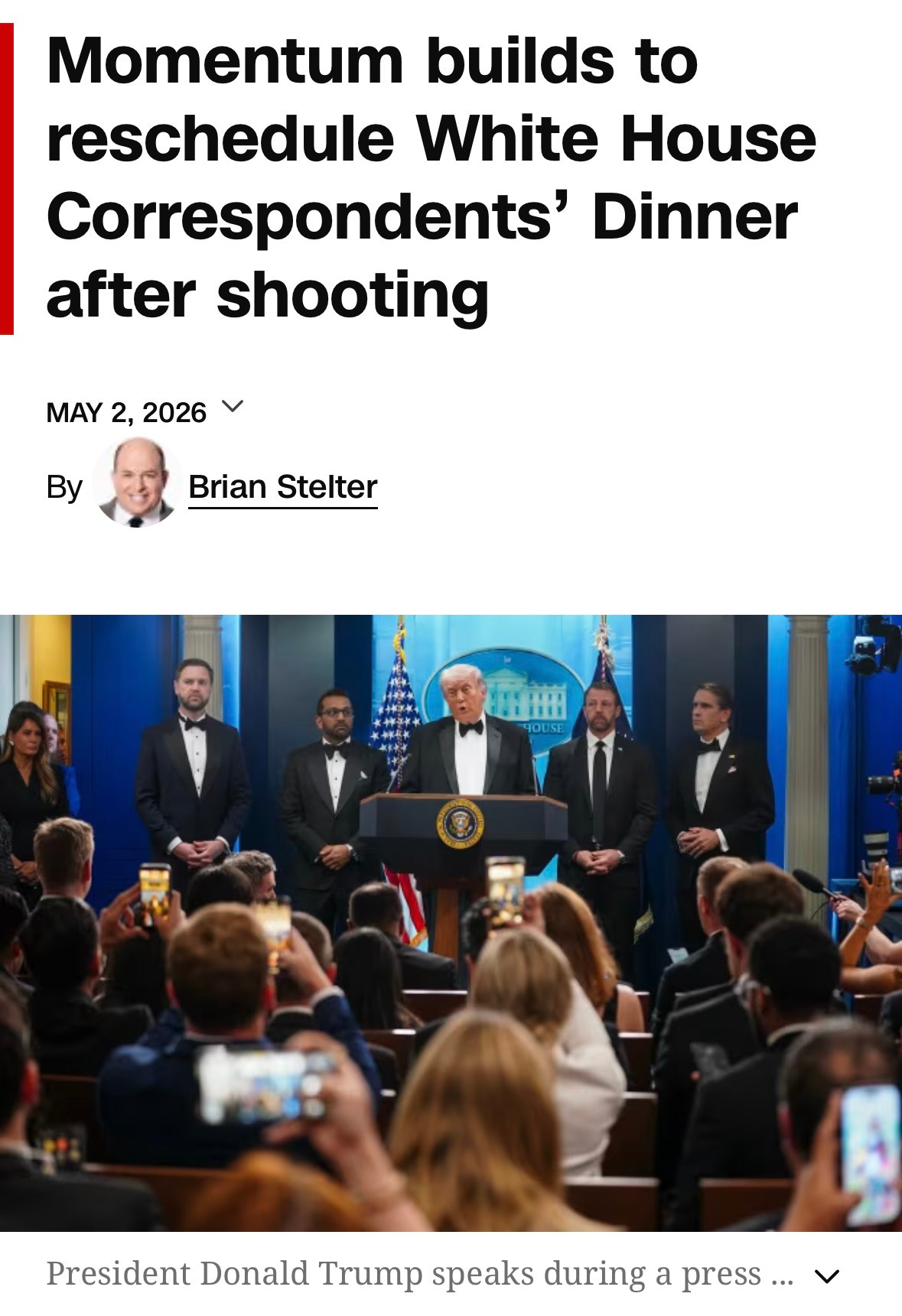
The whole week, the vibes were rancid even before the shooting. We would all be better off if this winds up resetting the whole multi-day Democracy x The First Amendment, sponsored by Titos’s Vodka and [European Embassy TBD] circus back to its one-night rubber chicken dinner factory settings. Yet two weeks out, and mainstream outlets are still running stories like this:
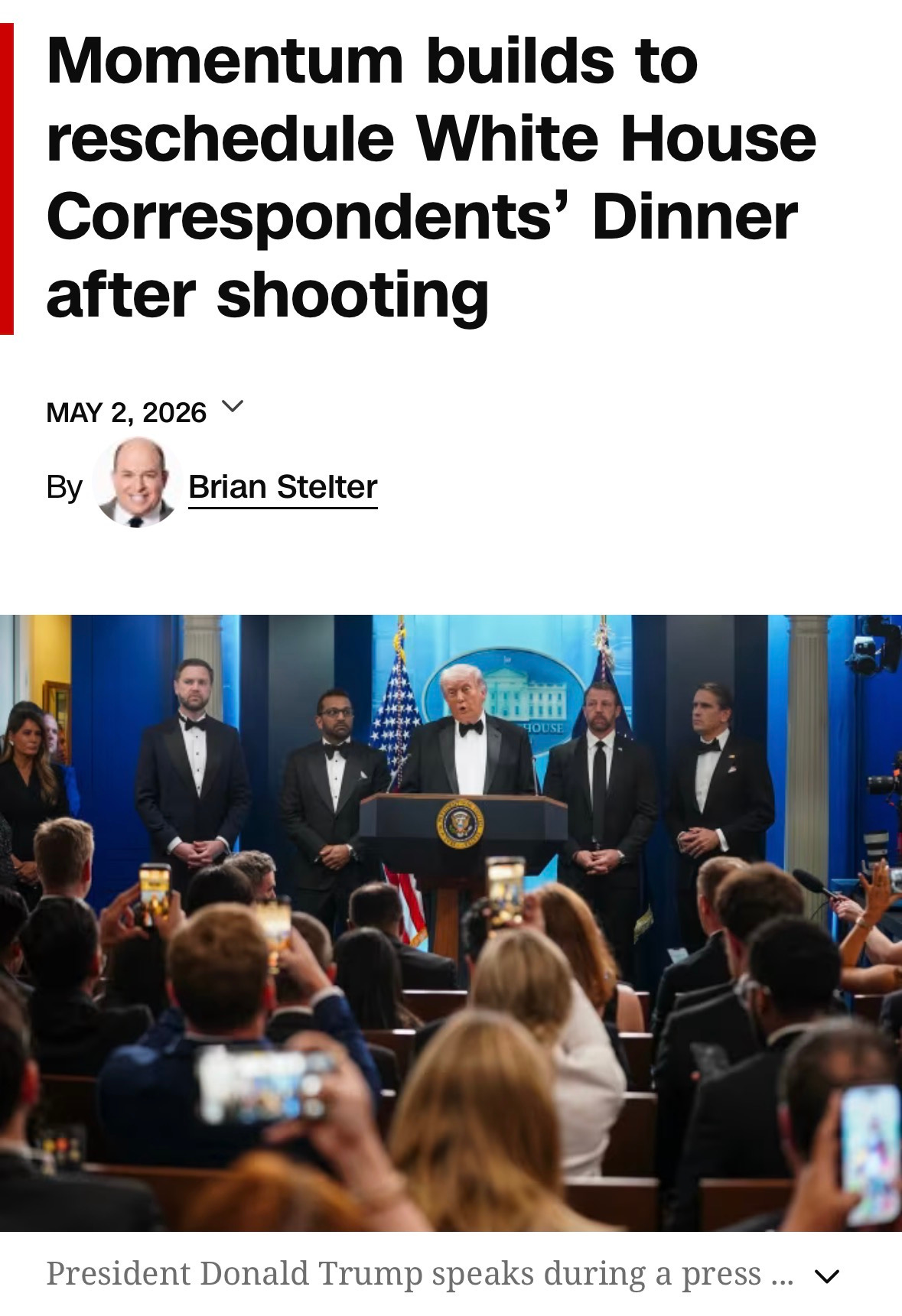
Just… no. Nobody wants this. Say it with me: who is this for? Not for the average American worried about gun violence in their communities, or gas prices, the opioid crisis, or AI job displacement, that’s for sure. Not for the person who still insists on the value of tough political journalism, but can’t defend a second attempt at its black-tie ritual humiliation at the hands of a President whose only visible joy comes from berating the reporters who cover him. And definitely not for people whose trust in legacy media was cratering even before this story dominated DC press for far too long relative to its impact on the rest of the country.3
The report from the Yale Committee on Trust in Higher Education. ICYMI, in April a ten-professor Yale panel issued a public report criticizing elite universities for having lost public trust in institutions. Tellingly, the report spends more time on Halloween costume-related emails from Yale staff than on the Trump administration’s weaponizing of research funding, arresting and attempting to deport foreign students for exercising their free speech rights, or pressuring colleges to eliminate entire academic departments.
In the 58-page report, there’s no mention of the entire right-wing media apparatus that spent decades attacking higher education. No mention of how TPUSA built an entire for-profit industry around activating campus conservatives in bad-faith debates. And no acknowledgement that perhaps Yale is not representative of higher ed writ large.
In academic terms, this report sucks. Hard.

A more intellectually honest critique of how elite higher ed has failed the American public Again: who is this report for? Not for professional cancel culture pushers, whose whole incentive is to keep manufacturing outrage and moral panics about picayune campus dramas. Not the Trump administration itself, which would never be mollified by a simple report when they’ve already been so successful in humiliating academia into submission. And certainly not for students, faculty, and alumni who want to defend their universities specifically and academic freedom as a principle. It’s unconvincing at best to critics and negatively activates would-be supporters.


The trust deficit in American media, institutions, and expertise didn’t come from nowhere. It was artificially accelerated by bad-faith actors and algorithm-driven outrage. But the Yale report did get one thing right, sort of: bad comms from elites have contributed to public distrust. An indulgent press release or tone-deaf profile here, an insider dinner or unsolicited white paper there— a steady trickle of insisting that they know best what the audience needs, even as the audiences are clearly rejecting what they’re pushing.
A lot of it was well-intentioned, or at least started out that way. Some of it was even objectively newsworthy (at least for a while). But all of it curdled because the communicator forgot that they weren’t the audience. The audience is the audience. Their vote matters most. And to reach them, you have to be ruthless about meeting them where they actually are, not where you think they should be.
“Why would anyone else care about this?” may sound harsh. But until that question becomes your North Star, the answer will likely remain “nobody, that’s who.”
I will not clear on a comms plan that has “the general public” as an audience, and anyone who does so is fleecing you.
Product (or occasionally, policy) will tell you that’s their job, but no, it’s not the same.
This is so hard to write about with nuance. Truly, I don’t fault anyone who was at the dinner or one of the locked-down parties and is having a tricky time processing the experience. But that doesn’t mean it’s still newsworthy weeks later, in a country that has experienced over 130 mass shootings in 2026 alone.
Products job is to center users and buyers, which may be among the audiences comms targets but usually is a much smaller subset. Meet them where they are is a shared goal, but the tools you’re using for impact are different: features, capabilities, UX.
Well said, Emily!