
"I Try to Assume Stupidity Instead of Malice:" Prism Media Investigation Part 2
We get into the weeds on VC due diligence and scaling data companies, and Peter Thiel makes a cameo


Update 8/17/26: Prism News’ websites are all down and displaying this message: “We have currently completed our initial experiment. A big thank you to all who participated and gave their feedback. All activity is suspended for the foreseeable future.”
If you haven’t read Part 1 of our investigation into Prism News — the VC-backed Israeli pink slime start-up — you’ll want to start there. You’ll learn about how Prism’s AI scrapes real journalism, Frankensteins it, and republishes it bylined by AI “reporters,” how Prism pitched a reporter’s own work back to him, and how they published the name of an underage abuse victim:

And please consider becoming a paid Spin Class subscriber to support research and reporting like this series (or you can buy me a coffee):
Note: As this article was being finalized on August 13, Prism Media’s websites went down “for maintenance.” As of publication, Prism outlets have been down for over nine hours. I’ll update with any further information.
What most intrigued me when I first started looking into Prism News was not the quality of its content (pink slime has been around for years), the AI of it all (inevitable), or even that it’s an Israeli company producing US local news (definitely noteworthy, but given the AI of it all of course non-US actors would eventually get into the space).
What most surprised me was that a reputable VC firm had decided to go into the pink slime news business. That’s what we’re going to unpack here.
But first: since Part 1, some readers flagged new reporting about how Prism spread misinformation about crime and natural disasters in New Mexico:
Local officials said in addition to grappling with natural disasters, they were also responding to a new AI news outlet named Prism McKinley County that they say has regularly published false and misleading information in a time of crisis.
For instance, within the last week, Prism published a story about a woman drowning in floods, but the death occurred last year, according to Matt Robinson, Gallup’s tourism and marketing manager. The misleading story caused people to believe the recent floods caused her death, he said. The recent flooding has not caused any deaths or injuries, according to city officials.
“They’re taking things that happened years ago that are negative, bringing them to light, scaring people, and sharing false information,” Robinson said. “It’s really not a good thing.”
Other misleading or false stories include one July 18 that reported that two women were robbed and beaten at a Walmart. The article goes on to say that the robbery actually occurred March 3, 2020, and Police Chief Erin Toadlena-Pablo told Source NM she does not know where the outlet got its information.
Still, the article received roughly 250 shares and dozens of comments, most of which decried security concerns at the Walmart, which is one of the main grocery stores in town.
The misleading posts prompted a Facebook post by the Gallup Police Department advising residents to use “verified sources and/or official government channels to obtain the most dependable information.”
With 200+ Prism News sites pumping out AI-generated and bylined articles daily, there are surely more examples like this floating around. But we’re going to pivot to talk about structure: where did Prism come from, the money behind it, and why this all matters — with a special guest appearance by one of the more notorious tech and media figures in recent memory.
“We will either crash or become Amazon”
Prism would not answer my questions about why its Israeli founders got into the U.S. local news business. However, it doesn’t appear that any of their four employees have ever worked in media. Instead, per their LinkedIn profiles, they appear to come from tech start-up backgrounds.
Prism Media (Prism’s News’s parent company; we’ll use Prism Media from here on out since we’re talking about its business side) CEO Dekel Valtzer, a former professional tennis player, is a tech entrepreneur and investor. Prior to funding Prism Media, Valtzer founded an e-commerce platform called Avo, whose business model he described in a 2021 interview as “we will either crash or become Amazon.” Avo shut down most of its operations just a year later, citing market changes and operational challenges. By then, Avo had raised over $90 million from Insight Partners, IBI Tech, Kleiner Perkins, F2 Capital and others. Meanwhile, Valtzer’s co-founder Nadav Klinger was previously a software engineer at several small Israeli tech companies, including two now-defunct dating apps.
Most startups fail (up to 90%, depending on who you ask). And sure, good ideas can come from anywhere. But local news is already a notoriously unprofitable industry. There’s an entire sub-industry dedicated to trying to hack this: through subscriptions, events, philanthropy, digital ads, etc. No one has figured this out, much less two co-founders with track records like theirs.
From Part 1: “The idea of AI-powered news is generally attractive to the Silicon Valley types” MediaWise director and Poynter Institute faculty member Alex Mahadevan told me in an interview. “If you’ve been to any journalism conference in the past two years, you’ve heard about the idea of news reporting and investigative reporting as basically the first layer of the news experience, which then is outsourced to AI: repackaging things as chatbots, as articles, as videos, etc.”
However, “when I look at Prism, I don’t really see a compelling product,” Mahadevan continued. “I see a defective product that, for the most part, is duplicating efforts from actual reporting that already exists. The images are poor. The layout is really poor. It’s not a very inviting user experience.”
“When I hear that there’s VC money flowing into this,” he added, “it’s insane to me to put money into [this] and expect any sort of ROI.”
I haven’t seen Prism’s pitch deck. But based on publicly available information, it’s feels hard to look at Prism’s Media’s founders and believe “yes, these are the people who have figured out how to make the first-ever profitable U.S. local news startup.” The real question is why anyone else would buy Prism’s pitch, especially given its cofounders’ lack of experience in either journalism or successfully scaling a U.S. tech company.
So: how did these founders convince a successful VC fund that they were the first people ever to figure out how to make local news profitable? “I try to assume stupidity instead of malice,” Mahadevan said. Wise counsel.
But if it’s not about making local news profitable, then what else is going on here?
The VC Backers
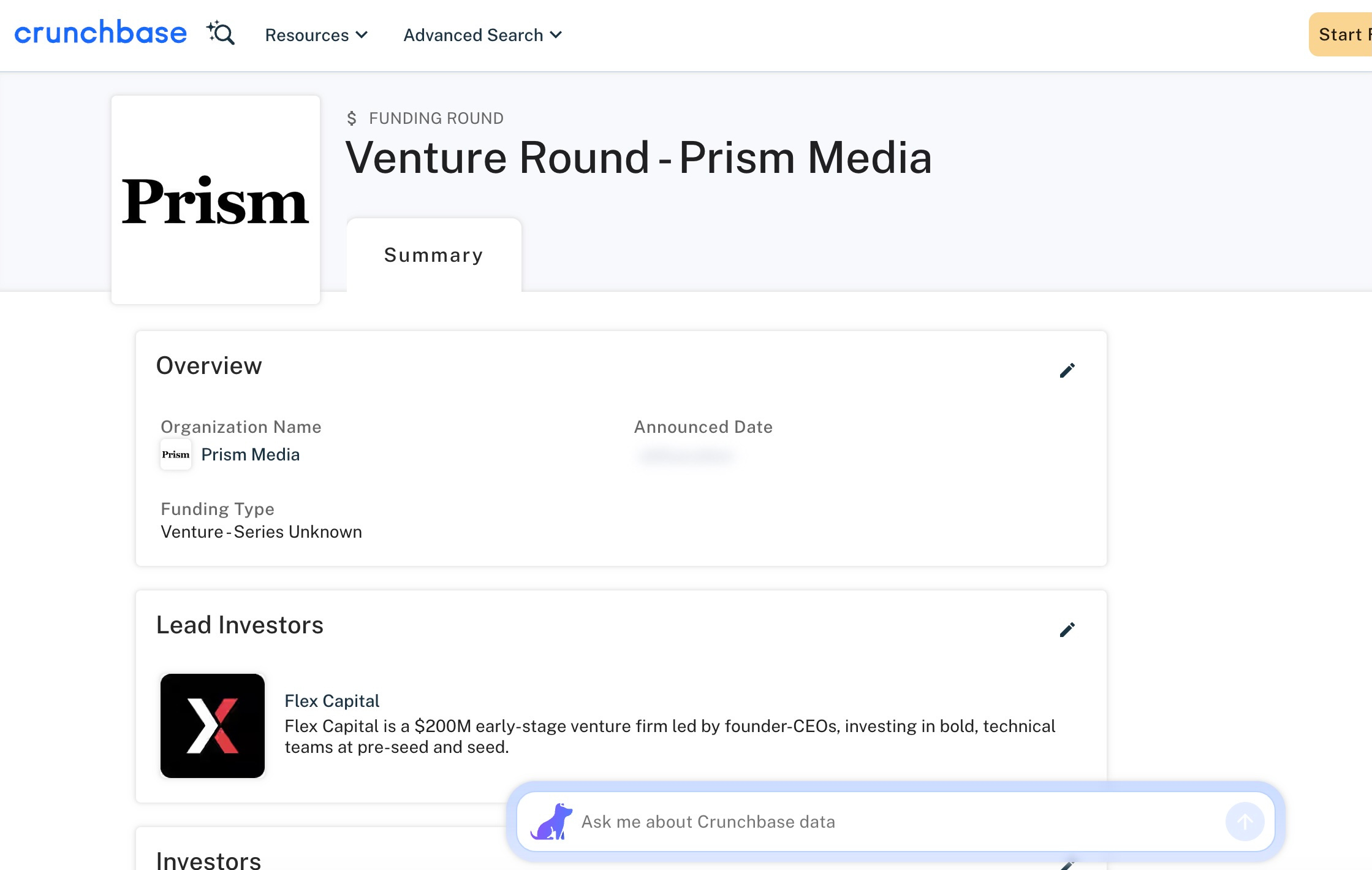
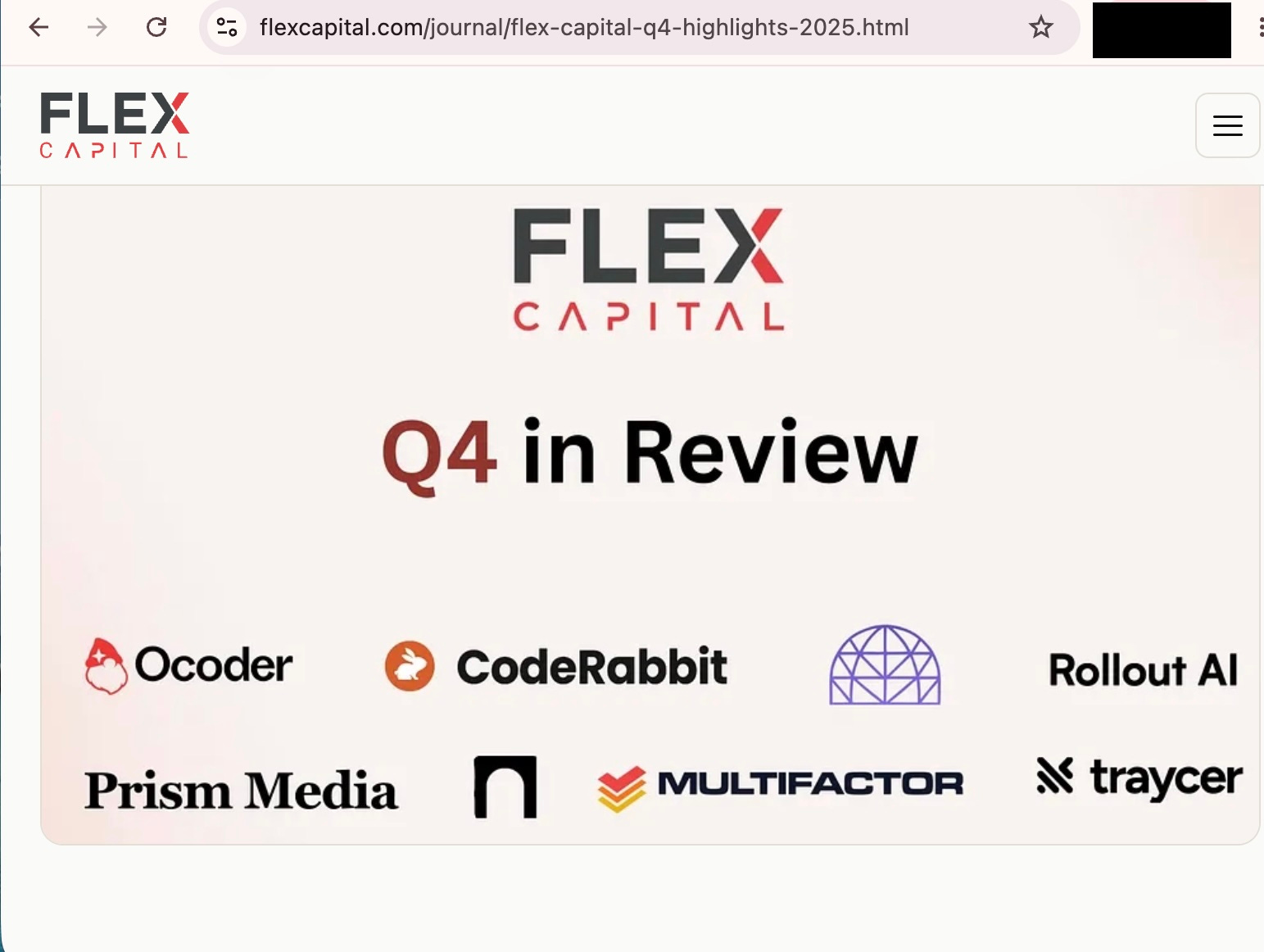
Per Crunchbase, Prism’s lead investor is the VC fund Flex Capital.1 Flex’s portfolio companies are tech startups: AI, fintech, enterprise SaaS, healthcare, and consumer (where Prism is listed). As best I can tell, they have no other journalism investments, making their investment in Prism Media an outlier. Flex has, however, invested in Threads, Rumble, and a number of start-ups focused on content creator and influencer tools. Flex included its investment in Prism Media in its new investments section of Flex’s Q4 2025 roundup, as “Prism Media: Local media reimagined for the AI era.”
Flex Capital’s partners have successful track records as founders who turned massive amounts of user data into huge profits, including LiveRamp (whose “data collaboration network connects every signal, agent, and platform to fuel and measure intelligent marketing”), digital advertising company BrightRoll, and SafeGraph (“We Strive to Be the Source of Truth About the Physical World”). These founders are experts at building the connective tissue of disparate digital and real-world data signals: everything from the cookies on websites you visit, to how long you linger on a served digital ad, to whether you still have a tangible loyalty card to a particular brick-and-mortar store.
Flex Capital’s track record and portfolio begs the question of what they are actually investing in: is it Prism’s AI news sites and the ad revenue they may someday generate? Or, alternatively, is it the user data that a large AI-powered pink slime network could generate and hoover up? Which was pitched to investors as the real investment opportunity?
When I emailed Flex Capital partner Auren Hoffman a list of questions about Flex’s investment in Prism Media, he initially responded that he hadn’t heard of Prism. I sent him a screengrab of Prism’s listing on Flex Capital’s website, adding that he appeared to be connected with Prism’s co-founders on LinkedIn. He replied that he was on vacation and could look at my questions later in the week “if urgent.” I extended my initial deadline, but never received a reply.
I wasn’t surprised that Flex Capital didn’t answer my questions. But I was taken aback that one of its founders initially professed to have never heard of it. Assuming that’s true, it says a lot about the money and power they wield, and how disconnected an investor can be from the impact one of their portfolio companies is already having in the real world. Given everything that we covered in Part 1 — Prism’s AI hallucinations, the real-world harms, the challenges of Prism’s business model and its impact on real journalists — I was curious whether Flex still had confidence in their investment.
I was also curious to learn more about the due diligence Flex had done on Prism: not just about the possible financial ROI, but whether or how they had quantified legal risk and factored that into their investment. Typically, a VC exploring a seed investment would do analyze the likelihood of lawsuits against the company and an expected settlement value range. The business model that Prism’s head of partnerships described in Part 1 felt like it would invite significant exposure, especially given the flood of publishers and media outlets suing AI companies over IP and copyright issues.2
”The Prism representative’s explanation could be more damaging than a simple ‘we copy articles’ admission would be,” media and technology attorney David Hoppe of Gamma Law told me in an email. “It essentially describes the fact pattern that sank the fair use defense in Thomson Reuters v. Ross Intelligence: building a product on someone else’s content that then competes with them for the same readers and ad dollars.”
Hoppe was more circumspect on whether this potential risk could extend to Prism’s VC backers. “Courts are reluctant to pierce the corporate form just because a fund wrote a check,” he noted. In other words, it’s not so much about whether the VC itself is exposed to legal risk, but whether the startup can absorb the costs of its own legal exposure on the path to profitability. However, Hoppe continued, “that changes if a VC has a board seat and keeps funding after actual knowledge of the pattern.”
It’s also worth noting here that, while we don’t know the size of Flex Capital’s investment in Prism Media, it’s possible that it’s quite small (in VC terms). Flex’s pre-seed and seed investments are generally between $500,000-$2M, per its website. But that small stake actually makes their Prism investment even worthier of scrutiny: given the ease with which a tiny team can quickly vibe-code hundreds of “news” websites, a relatively small amount of money for a pink slime network in 2026 has an outsize real-world impact.
In VC terms, this outsize impact could read on a pitch deck as great ROI. In real world terms, it means an entire new local “newsroom” appearing as a competitor from out of the blue, after just a tiny influx of cash. And it means AI hallucinations about real people causing real impact, sometimes harmful, with no recourse other than emailing an anonymous help desk at a four-person start-up.
Because it’s not just the fair use/IP theft cases. Remember from Part 1 how Prism’s AI correctly identified and published the name of an underage abuse victim? Attorney David Hoppe told me, “Publishing a minor abuse victim’s identity that the original reporter deliberately withheld fits the privacy tort of public disclosure of private facts, plus a straightforward negligence claim, since no reasonable editorial safeguard caught it before publication.” “Since the original story omitted the name entirely,” Hoppe continued, “the key question is where Prism’s system got it. If the name came from an inferred or scraped source never meant for publication, that would seem to increase the liability risk.”
There seem to be several different vectors through which a company like Prism Media could be legally vulnerable, that a reputable VC firm would probably surface during due diligence. VCs accept legal risk in their investment bets all the time: think of Uber, Airbnb, and other mega-startups that are regularly exposed to significant legal risk while still not yet turning a profit. The bet for companies like those is that they will eventually garner enough users that the legal and financial risks can be absorbed along the company’s path to profitability.
But journalism’s business model is fundamentally different— arguably incompatible— with a VC fund’s need to turn the kind of profits that make the legal or regulatory risks worth the bet. Local news is notoriously impossible to make profitable, even without all these additional legal vulnerabilities. So what convinced Flex that their investment was worth the risk?
It’s possible that Flex assessed the risks but determined they were sufficiently mitigated by other factors (say, for instance, the challenges of a U.S. plaintiff suing a foreign-headquartered company). Also possible: they didn’t particularly care. Flex Capital is a $200 million fund; from their perspective, a small investment in a tiny AI news start-up that flames out is just another day at the office. There are lots of reasons VCs make relatively small pre-seed investments, not just because they truly believe in the business model.
There’s another reason, which would be germane for a VC fund with such a strong track record in data companies. As the cliché goes, if you’re not paying for the product, you are the product: something that the founders of successful data companies would keenly understand. It’s not hard to see how an AI-powered pink slime news network could cheaply generate a trove of valuable data: audience intelligence, what narratives resonate at a hyper-local level, etc.
Does Flex Capital’s background in scaling massive data companies have anything to do with why they’ve invested in a pink slime news start-up? I still don’t know. But I remain curious.
Peter Thiel Enters The Chat
Flex Capital cofounder and SafeGraph CEO Auren Hoffman’s name may sound familiar: he was recently in the news for his role as the co-founder, with Peter Thiel, of an elite members-only gathering called Dialog.3 Thiel has made his own investment forays into local journalism recently, notably backing a local government news start-up called State Affairs. Hoffman did not answer my questions about whether he and Thiel have discussed their respective local journalism investments, and whether the timing was simply a coincidence.
There are important differences between Prism Media and State Affairs, particularly that State Affairs is not traditional pink slime. It employs actual human journalists to produce actual reporting on local statehouses and legislatures. Still, both Prism and State Affairs have business models that center AI, not journalism, even as they make big claims about bolstering the struggling local news industry. Per the Washington Post:
This venture puts a twist on local reporting. The stories produced — without AI — will then be fed into a large language model, with the goal of organizing the information for high-paying subscribers from companies, nonprofits, and governments.
I debated whether to include this element, knowing that invoking a name like Peter Thiel unlocks a whole other level of galaxy brain for many people. And it’s important to be clear that I have far more questions that answers here.
But it’s worth bringing Peter Thiel’s foray into local political news into this discussion because of Thiel’s ties to Flex Capital’s leadership, his history of waging lawfare against journalism, and the broader track record of right-wing millionaires mucking around in the U.S. local news ecosystem. When someone like Thiel, who infamously claimed democracy and freedom were incompatible, who bankrolled the legal fight that eventually killed Gawker, starts investing in local journalism outlets, it’s a big deal.
And: When someone close to Peter Thiel is involved, even tangentially, in financing a foreign-headquartered, AI-supercharged pink slime news network, it’s worth asking questions about what exactly is going on — even if we can’t always find the answers.
This is especially important to probe given the recent history of U.S. pink slime journalism: overwhelmingly politically conservative, backed by right-wing dark money groups, astro-turfing the look and feel of local news to secretly advance a political agenda. Prism’s content to date lacks the sensationalist, hyper-conservative slant that animates older networks like Metric Media or the network of six Republican dark money-backed pink slime sites that independent journalist Judd Legum recently uncovered. But that’s the thing about AI-powered journalism: a few tweaks, and suddenly the tone and cadence of the network you’ve built and scaled, crowding out actual local journalism, could easily flip overnight. Thiel would obviously know all this. It’s anyone’s guess how much he’s discussing this with his known associates.
It’s also not difficult to imagine that the kind of data a pink slime company generates could be extraordinarily valuable for political (or geopolitical) purposes. Prism’s spokesperson insisted that Prism has never “been approached by any government or political organization regarding content distribution.” But, of course, there’s no promise that would never happen — or way to tell how Prism Media would respond should its investors press Prism to broadcast a certain type of content, or to use its data for certain purposes.
It's frustrating to be left with more questions than answers. It’s also hard to write about this stuff without feeling like you’re dancing around the edge of a conspiratorial rabbit hole, especially when names like Peter Thiel start emerging in your research.
But it’s still worth publicly discussing the many unresolved data points in Prism Media’s story and asking whether/how they could be related, especially whether there’s a hidden intent behind the public-facing marketing materials. There are very few ways to map the networks of a small, powerful cohort of people who increasingly fund and control so much of what the average person sees in their local news— and it’s often in their interest to keep their dealings and intentions opaque.
Meanwhile, Prism’s real world impacts are already here and likely to only grow with the company. If Flex Capital loses its bet on Prism, it would be a small blip in their overall portfolio. But even a failed Prism Media could inflict real harms on individuals and communities encountering its misinformation along the way.
It matters to the journalists whose careful reporting is being scraped, Frankenstein-ed, and fed by AI back to the same audiences they’re struggling to reach.
It matters because local media publishers and niche journalists, already competing with right-wing millionaires increasingly taking over broadcast and print outlets, now have to fight them on a new AI-powered digital front.
It matters to local audiences, unaware that the news they’re seeing on Facebook or Nextdoor is AI-generated, backed by investors who typically anticipate a huge fail rate for their portfolios — but who have also successfully backed unicorns that traffic in massive amounts of online and offline user data.
And it matters to everyone sick of fighting whether truth is even knowable anymore, but still being force-fed the slop because a small group of very smart, very wealthy people figured out how to serve ads against and harvest the data on how we react to it.
It’s entirely possible that this is a yet another story of overconfident investors who made an ill-informed bet, and nothing more. It certainly wouldn’t be the first time a some dudes convinced some other dudes to give them a lot of money to revolutionize (™) a struggling industry they don’t really understand. Though, of course, that’s troubling in its own ways: it raises important questions about who does and doesn’t get access to start-up capital, who gets to fail big but keep making big swings, and who gets to decide how much real-world risk gets inflicted on an unsuspecting public along the way.
But the danger in settling for the simple stupidity over malice explanation is that it overlooks a long track record of pink slime as a vector for right-wing astroturfing, which has helped accelerate the public’s collapsing trust in journalism. And that’s to say nothing of Prism’s unique, worrying combination of foreign headquarters + VC funding + a stated goal to disrupt local news.
The people who invested in Prism Media know how to build valuable companies from the data we all unknowingly generate just going about our lives. If Prism’s backers are really betting on fixing local journalism, as they say, it’s a strange bet. But if they’re betting on what a journalism-shaped data network can harvest about local audiences, human anxieties, and what narratives spread where and why— well, we’ve seen that play before. Adding what we know of how that turned out with how pink slime has operated to date in U.S. politics and media…
Yeah, that’s something to keep questioning.
Not flex.capital, a mistake that bad Google AI summaries will repeatedly direct you to despite your increasingly irritated admonishments.
From Part 1: “Several of your questions appear to assume that we copy and republish articles,” Prism told me in an email. “That is not how our system works. Instead, we use licensed AI search tools together with publicly available facts and data to gather factual information about stories from multiple independent sources. Our system then synthesizes and transforms those facts into a completely new article, written from scratch, often with additional context, a different structure, and a different editorial angle based on what the system determines would be most useful for readers.”
Side note here that, as someone who has previously attended Dialog events, I found that press cycle strange and fairly silly. The real story was hiding in plain sight: not about individual conferences or their sessions, but about how the same kinds of people keep getting invited into the same kinds of places, and how that creates informal but very real networks that replicate power in a closed loop. How they validate one another’s choices while insisting together that they’re the only ones brave enough to say that which others are too afraid to admit (basically the entire business model of the Free Press is selling this cohort’s groupthink back to them as forbidden knowledge, and it’s brilliant). And yes, often they invest in each others’ companies. But that’s a whole other essay.