
Spin Class Interview: Maria Comstock on the Creator Ecosystem, NATO, and Satirizing #ThisTown
"You don't get to opt out of an information war because you find the battlefield undignified"

I first encountered Maria Comstock’s “Ask A Retired Spy” videos of her (deadpan, hilarious, clearly-seen-some-shit) dad about a year ago. From there, the algorithm quickly started feeding me more videos that quickly became group text fodder: gentle parenting DC guys,1 the hypocrisy of “pro-life” talking points, and a Gen Z take on the most DC couple you know:
“He was leg, I was comms!” Savage (compliment).
Maria has built an audience of millions across both Instagram and TikTok because her videos take the Serious Issues Seriously, while casting a gimlet eye on the absurdities of life in political/policy circles. Satire must understand something deeply in order to mock it effectively, and Maria clearly knows her stuff. I’m also a big fan of how vocal she’s been about how the far right’s creator investments have paid massive dividends to terrible people. She regularly calls out the disparities in everything from commissions to systemic support mechanisms (which she rightly pushed me on in our conversation).
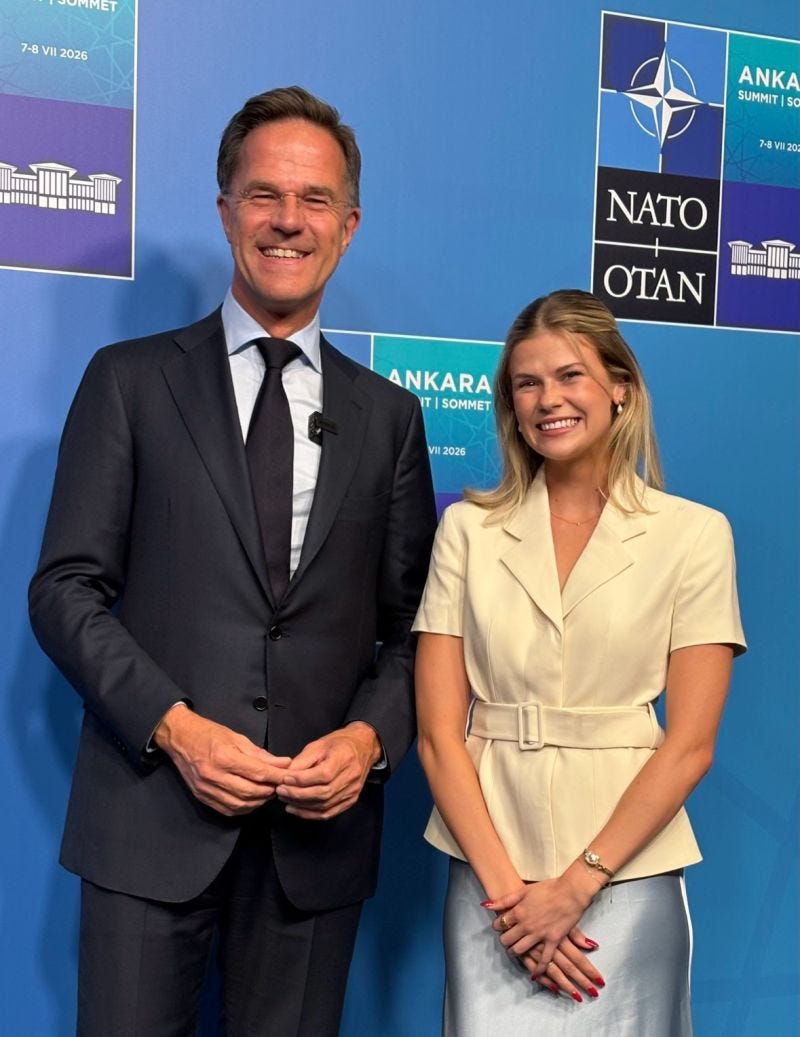
But I was especially excited to chat with Maria after reading about her experience covering the recent NATO Summit:
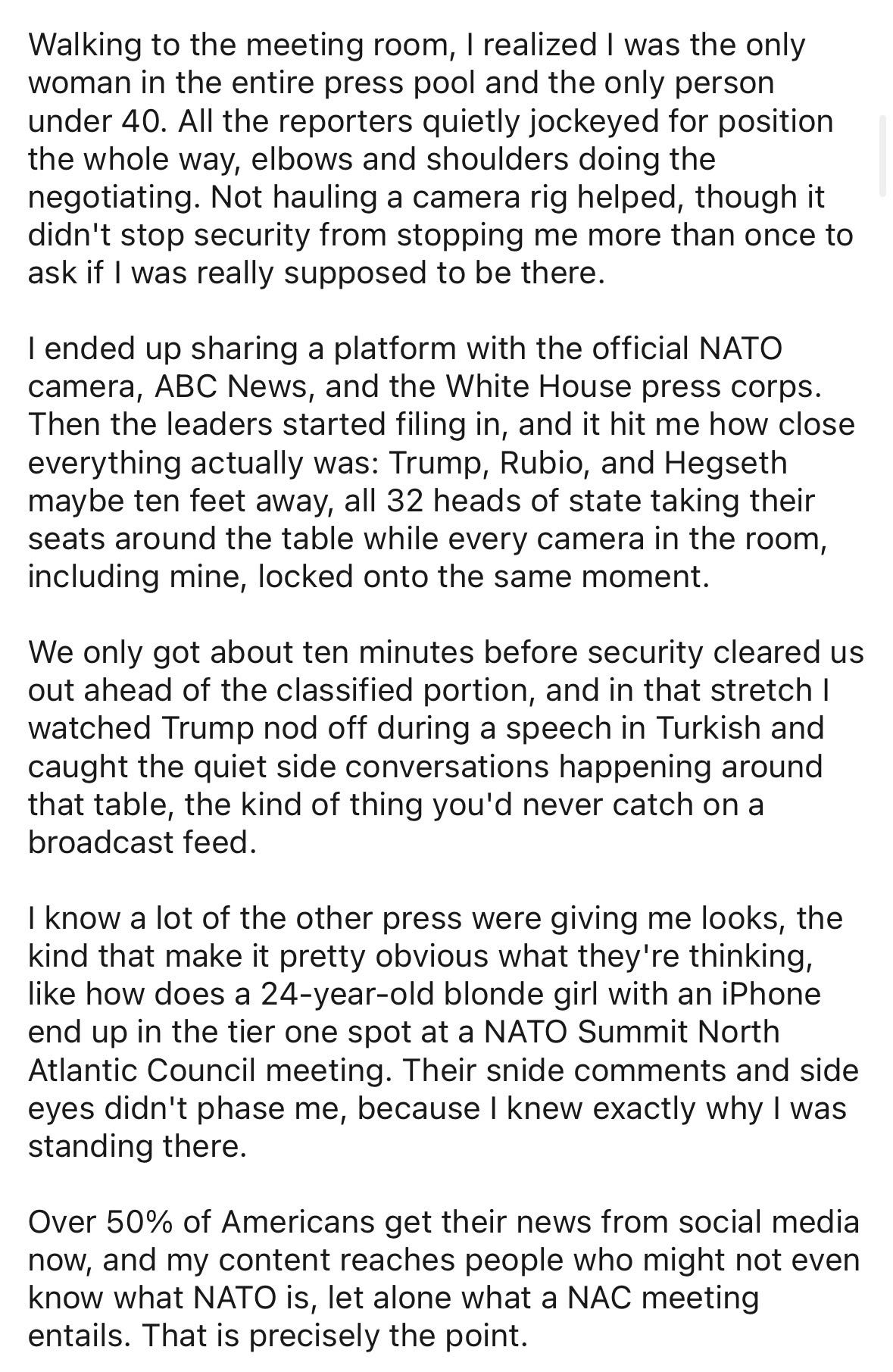
PREACH, WOMAN. More of this energy! I learned so much from my conversation with Maria, and think you will too. But if you can’t read the whole thing, then sit with this key point on your Metro ride to work (and maybe send it to your boss and/or funders):
My entire reach lives on platforms I don’t own and can’t appeal to. One algorithm change, one policy shift, one geopolitically-motivated ban, and the audience I spent years building is gone overnight. The whole model rests on a single human face staying healthy, safe, funded, and un-deplatformed indefinitely. That’s a lot of single points of failure for something people increasingly treat as news.
So when people ask how to build the next generation of creators, I wish the question were less “how do we get more of them” and more “how do we make this survivable for longer than eighteen months before someone burns out, gets scared off, or gets their account banned.” Fund the work, of course. But also build the scaffolding, legal, security, financial, that lets a person do an institution’s job without being quite so alone at it.
First: what’s your preferred title? Content creator, influencer, independent media, etc. (this feels like asking someone for their pronouns). What’s the tl;dr on how you got into this line of work?
Content creator! When I was 16 I found out my dad was a spy. At 18, I got my first smart phone, and by 19, I had gained a million followers posting interviews with my dad on TikTok. After graduating from UC Berkeley with a degree in Political Science and specialization in American Politics, I moved to Washington, DC and began a career in politics. Today, I have my own firm while maintaining my spy interview channels (Instagram, TikTok). I also do political satire and advocacy videos (Instagram, TikTok).
I started my interview channel as a complete joke - the first interview with my dad was recorded on a shaky Google Pixel, to my audience of 19 followers, and I asked him if birds were real. That first clip got maybe 30 views, but on a whim, I did a second interview, which hit a million views overnight. When Covid hit, we did a video encouraging our audience to get vaccinated, the response was so positive, with comments like “I wasn’t going to, but if your father did, I will too,” that it made me switch my major from Applied Mathematics to Political Science, to study the impact the digital world has on political persuasion.
Your dad is such a great character and I love his videos. How important is having a character or persona like him in creator work? Is that part of the secret sauce national security nerds are missing?
Well I love my dad too!! I think his personality and endearing Texas accent definitely adds a lot to the channel. He is incredibly outgoing, good humored, and kind, which makes him likeable online. It’s more than just his past; our audience has a real genuine connection with his personality (you should have seen the commotion around him growing a man bun LOL).
How did the invite to cover NATO come about? What was the experience like? How did you see your role compared to legacy media reporters there?
When I got the invite from NATO the first time, I honestly thought it was a scam! I couldn’t even fathom the honor of being invited to any NATO activation. After double checking and verifying the email addresses it came from, I timidly responded with my interest to be involved.
The first engagement I went to was in Tallin, Estonia - the yearly Cyber Security activation. They flew me and eight other creators from around NATO-allied countries out to Estonia for about three days, and we got to hear from top NATO and Estonian officials, see behind the scenes of the-red teaming, and even participate in a mock simulation ourselves. (Interview 1, Interview 2, Post recap).
I was even more awestruck when I got an email for the second time inviting me to be a creator at the NATO Summit in Ankara, Türkiye. This time, it was 28 creators… oh and every leader of every NATO country. [Note: Maria has great write-ups of pre-post, Day 1, Day 2, and Day 3 over on LinkedIn that anyone who wants more on setting creators up for success at these kinds of events should study]
Overall, the experience was phenomenal. We were treated similarly to traditional media, and at some points had even more individualized access than some major outlets. The content I produced across channels gathered millions of views, and more than just a big number, it hit younger audiences that would normally not engage with NATO activity.
What does success look like for creators at gatherings like this? Is it just about the clicks and engagement rate?
It is much deeper than just the analytics. Yes, views and engagement matter, but also we are there to break the echo chamber. Our audiences are the people who may have tuned out of traditional media, people who are tired of being lectured to from a podium, and instead want to see news translated into terms they understand from people who look like them. Success for every creator was different, some of us did interviews, some did games, some just did recaps. All are valuable and hit different niches.
What should future national security and government gatherings do differently next time to set you for even more success?
NATO actually does a phenomenal job already: they set aside content time, had great backdrops, and set us up with 1-on-1 interviews with important people. The biggest pro here is that NATO believes in a truly free press, so there were no scripts or talking points, just the freedom and time to create content based on the activities of the day.
When you’re at an event like NATO as a creator, how do you balance what the algorithm wants with what the host invited you there to do? How do you think about meshing your own brand with what’s expected of you in a setting like that?
I think the whole point of inviting content creators as free press is to not balance that, it’s to let the creators be free to communicate however they normally do. If NATO had a script, they would buy an ad. Instead, they wanted storytellers: so each creator produced wildly different content, and that’s the whole point. No matter where you put me, I will always be Maria Comstock.
Shifting to your audience: why makes someone want to learn about NATO, or Iran policy, or Venezuela, through a content creator vice traditional journalism?
There are a couple of points here: 1, medium; 2, messenger. For the first point, social media is a lot more approachable and interactive than traditional journalism. A viewer can have conversations in the comment section, directly message me a question or thought, or reshare the content directly with their friends/family. This interaction produces a feeling of agency old media sources can never replicate: no more yelling at the TV when you don’t like what a news anchor is saying. Instead, yell in the comment section!
As for 2, the messenger: content creators use their platform in many versatile ways that produce a more encompassing picture of who we are. In between interviews, I am also posting pictures of my cats on my story. While at NATO, you also saw the Turkish food I was consuming. This makes the “news” content even more immersive. Yes, I’m talking to the Secretary General of NATO, and also, I had Turkish ice cream earlier. It makes the news a part of a bigger narrative about the creator, a viewer can understand the perspective of the creator, and why they are communicating the way they are.
Where do you think your work fits into someone’s information diet? What do your audiences get from you that they can’t get elsewhere?
Each of my channels provide something unique. For my spy channel, honestly, it’s relatively difficult to get some of those interviews, so the content alone is unique.
On my political comedy channel, I like to think that the satire behind each of my skits is really just a clever disguise for education. Yes, my character is funny, and then BOOM now you know a stat about income inequality.
You’ve been vocal about how many more resources the political right is investing in creators than the left. Why is the left still so bad at this, despite months (years, now!) of creators screaming that the right is eating our lunch on creator engagement? Is anyone doing this well?
My theory behind it all is that the right is about a decade ahead of us on new media investment. When the left began dominating a lot of the traditional news media, the right moved resources to the digital world. They have done honestly an amazing job at not only shifting messaging, but also shifting culture. They invest in lifestyle, not just news.
The issue on the left is, plainly, the consulting class. The old men running the big political consulting firms in DC who have a foot in every big race across the country haven’t figured out how to make a commission off of social media, so they keep lighting money on fire by buying TV and radio spots for 10x the price.
How should progressives and pro-democracy legacy organizations better support creators and influencers - is it as simple as “we need more money,” or are there other things we’re missing? What would make the biggest difference in correcting this imbalance?
Funding is definitely a big part, but also, it needs to be a coordinated shift. Begin incorporating creators into the programs we already have, as strategists, as speakers, as organizers, as reporters. Access is paramount.
But, to reiterate, many creators get more views than CNN and FOX. So paying them for their time and channel is the bare minimum when you are almost guaranteed a better ROI than a TV ad slot.
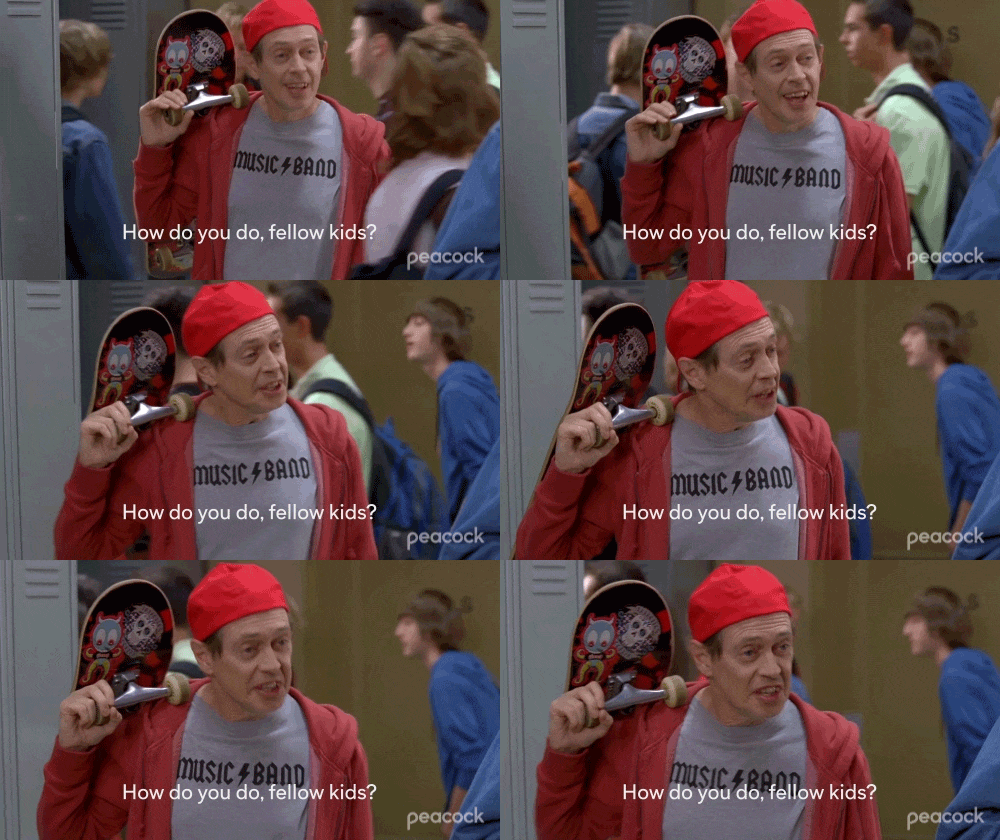
Spin Class’ audience has a lot of national security nerds and legacy media fans (love you guys!), and occasionally I’ll hear pushback from readers is that national security is an exception to the content creator boom because the issues are too complicated, too weighty, that doing a short-form video on a complex policy/history issue is unserious (paraphrasing here, but that’s clearly the subtext). I disagree, for a slew of reasons, but am curious how that sits with you. What’s your argument to the natsec audience for why they need to get on the creator train? And how can national security types think about supporting the next generation of creators without slipping into “how do you do, fellow kids” narc energy?
Love the “too serious for TikTok” crowd. But that argument has it exactly backwards.
The premise is that national security is uniquely too complex, too weighty, too important to compress into 60 seconds. And sure, it’s complex. But “this is too important to be popular” isn’t a serious position. The nightly news compressed the Cold War into six minutes between detergent ads. An op-ed compresses a foreign policy into 800 words. Every format is a compression problem, short-form is just the newest one, and a lot of the people sneering at it are the ones who haven’t figured out how to do it.
The information environment isn’t a sideshow to national security anymore. Our adversaries figured this out a decade ago. Russia doesn’t publish 8,000-word think-tank reports to move Americans, it makes content. Some of the most effective propaganda operations running right now are native to exactly these platforms and frighteningly good at the format. So when the serious, sourced, credible people decide the venue is beneath them, they forfeit the field to whoever has no such scruples. You don’t get to opt out of an information war because you find the battlefield undignified.
A good 45-second video isn’t a replacement for the deep report, it’s the front door to it. It’s the thing that makes someone who’d never open a CFR paper suddenly want to. The choice was never “great video vs. great essay.” It’s “decent video vs. that person never encountering the topic at all.”
As for supporting the next generation, that specific cringe comes from one move: trying to become a creator when that’s not you. So don’t.
What we need is for you to say yes to the interview. Be the source. Be the fact-check. Lend the credibility you spent thirty years earning and let someone else handle the editing. The best thing an establishment expert can do is treat creators as colleagues doing translation work rather than a youth-outreach box to tick.
What is the “supporting creators” conversation missing? What are we not talking about that we should be talking about?
What it actually costs to be the person standing where an institution used to stand.
This whole conversation, including about half of this interview, is about how to get more creators into the room. More funding, more access, more people translating this stuff for audiences who have tuned out. But nobody wants to talk about the other side of the ledger: when you replace an institution with a person, you inherit every fragility a person has and lose every protection an institution offered.
When a legacy reporter publishes a Russia scoop, there’s a newsroom behind them: an editor, a legal team, a security protocol, a brand that absorbs the backlash. When I post something that lands wrong (or right), it’s me, my phone, and my DMs. There’s no comms department standing between me and the guy who decides he wants to find out where I live. I’m a private citizen doing work that brushes up against state-level stuff, with none of the institutional armor that used to come standard with the job.
And the fragility is structural, not just personal. My entire reach lives on platforms I don’t own and can’t appeal to. One algorithm change, one policy shift, one geopolitically-motivated ban, and the audience I spent years building is gone overnight. The whole model rests on a single human face staying healthy, safe, funded, and un-deplatformed indefinitely. That’s a lot of single points of failure for something people increasingly treat as news.
So when people ask how to build the next generation of creators, I wish the question were less “how do we get more of them” and more “how do we make this survivable for longer than eighteen months before someone burns out, gets scared off, or gets their account banned.” Fund the work, of course. But also build the scaffolding, legal, security, financial, that lets a person do an institution’s job without being quite so alone at it.
This is such an important point: supporting creators isn’t just about access, but respecting and creating the infrastructure around this as a viable, sustainable career path. Marrying this with the earlier question about why the right is further along: what about how they support their stable of creators should we be stealing for our own playbook (not in a “Joe Rogan of the left” way, but delivering on practical supports like legal support, security, etc.)?
Honestly, quite a bit of it - top tier conservative creators get actual retainers, not just exposure. The business behind the deal is structured and part of a wider infrastructure. On the left, we basically treat creators like volunteers with a ring light. We’ll fly someone out for a panel, thank them for their “important voice,” beg them to post a video for free, and then leave them out of the rest of the conversation.
What we need to do is something like a shared legal fund that creators can tap into when something they post suddenly gets them death threats. There need to be trainings on account security, comment moderation, and best practices. And, of course, funding that makes the content produced worth it (and feasible) for everyone involved.
Haven’t dated in DC for almost two decades but good to know “We do not use our security clearance as a pick-up line! All it does is show nice women that we know how to lie!” is evergreen across the generations
Great interview. I often think about individual versus institutional advantages and disadvantages in media. If the legacy media companies were smart, they would hire the best creators like Maria and give them the support they need to expand and do great work.