

I skipped the Munich Security Conference this year, but kept up with the news and gossip. The Tuesday after the conference ended started like any other day: I opened my eyes, opened my email, and scanned the various media and political newsletters that fill my inbox.
But what I saw Tuesday morning was a sea of fury about Alexandria Ocasio-Cortez and Gretchen Whitmer’s event four days prior. It was seemingly everywhere, including in POLITICO Playbook and an exclusive New York Times interview with AOC on the “fallout” from her appearances in Germany, and what AOC and Whitmer’s comments say about Democrats and foreign policy.
Did I miss something? I’d half-listened to their event while folding laundry on Saturday and didn’t think much about it. If anything, it felt reassuring to hear AOC and Whitmer onstage with NATO PermRep Matthew Whittaker, who dutifully recited the necessary administration talking points but minus the vitriol and weirdness I brace for whenever a Trump foreign policy official speaks in public these days. It was downright soothing.
I had indeed missed something: over the long President’s Day weekend, a phalanx of right-wing actors launched a coordinated attack on AOC and Whitmer, driving inflammatory, often sexist social media content that was then amplified by more palatable MAGA and Republican voices until it broke into the mainstream.
And six days later, this narrative has calcified as conventional political wisdom:

We’re going to get into how that happened. But first, let’s talk about pink slime. I promise, this will matter later.
What is Pink Slime?
Per Poynter:
“Pink slime” journalism is named after a meat byproduct and describes outlets that publish poor quality reports that appear to be local news.
As local news sites have either gone out of business or are struggling to survive, and pink slime sites have replaced them.
These outlets claim to cover local and hyperlocal news, sometimes taking advantage of news deserts.
Pink slime sites are frequently produced via automation and templates. Look for text that’s more generic than expected, or articles that are pure information without context — that’s a giveaway you’re looking at a pink slime website.
Often, they’re funded by outside companies with a partisan source of financing.
ProPublica, CJR, Margaret Sullivan (then at the Post), Jane Mayer, and many others have written urgently about the dangers of pink slime, but it’s still not a widely-known term. I teach my students about pink slime in our unit on local news, and media-savvy undergrads are usually horrified to learn that there are more pink slime fake news websites in the U.S. than there are local news outlets.
Pink slime content overwhelmingly has a conservative partisan slant. Most of the known major pink slime networks are funded by right-wing dark money groups and billionaires. Around the early 2020s the biggest known node was Metric Media, owned by Brian Timpone, which as of 2022 owned around 1,300 pink slime websites pretending to be local news outlets (this excellent study by the Tow Center for Digital Journalism at Columbia goes into full detail).1 Those networks were supercharged around the 2020 and 2022 U.S. elections, with Metric Media websites alone reportedly pumping out five million articles a month in the run-up to the 2020 elections.
More recently, pink slime sites have started weaponizing FOIA requests and targeting colleges and universities. As the Tow Center wrote in September 2025:
Six years ago, when the Tow Center started its research into “pink slime” networks of local news sites, it seemed to many of us that these networks could not be real competitors to independent journalism because they were so ineffective and diffuse. We thought the marketing tools they produced for politicians would be limited by low quality and fail to get engagement. But pink slime networks have not withered. Instead, partisan news, whether directly funded by political interests or just indistinguishably aligned with those interests, has become not only acceptable, but actually a predominant force in political campaigning.
Pink Slime and The Post-Munich Narrative
So Tuesday morning, four days after the Munich session featuring AOC and Whitmer, I read this in POLITICO:
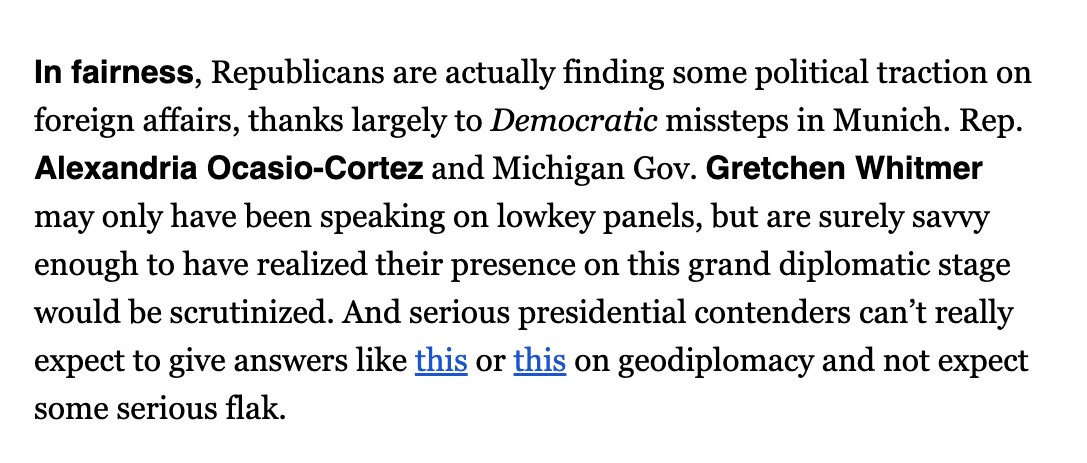
Those two hyperlinks direct to tweets from Eric Daughtery, a right-wing troll whose X bio reads in part “Charlie Kirk: ‘Men Must Vote.” Asking this gentleman what he thought of AOC’s foreign policy comments is like asking Harvey Weinstein what he thought of your daughter’s school play.
But it’s the second POLITICO hyperlink, which was also included in the New York Times’ post-Munich AOC story, that first confused and then alarmed me:


I’m a native Michigander and try to keep up with local news. I’d never heard of this outlet. Nor had any of my family or friends who live there. But that X handle looked sketchy. So I started researching.
The Midwesterner purports to be a Michigan local news outlet. Per the Wayback Machine, the Midwesterner first appeared on February 4, 2023. It appears to have appeared online fully formed, with no announcement or notice. There’s no masthead, About section, or way to contact reporters. There are no ads, paywalls, or paid subscription options.
Many of the links from that first Wayback appearance are now broken, but what remains intact appears to be scrapes of legit local news outlets, most with a sensationalist and/or right-wing headline.

In other words: classic pink slime.
Today, the model has evolved. We’ll get more into that in a future Spin Class. But there’s still no masthead, About section, or way to contact anyone who works there beyond a general info email address. There are still no ads, paywalls, or paid subscription options. Most of the articles are written by “The Midwesterner Staff” and there’s a suspiciously large volume of content across the site, the vast majority of it resembling AI-generated slop. Everything is still hyper-conservative and sensationalist.
It’s still pink slime, just an updated 2026 version.
But I didn’t know any of this when I saw the same tweet quoted in Playbook and the NYT. I just noticed a Michigan news outlet that I, a Michigander, had never heard of, being highlighted by two outlets I regularly read. And I wanted to understand more.
“Who Owns The Midwesterner News?”
I’m not a journalist, I’m just curious. So I simply Googled this question. And this was literally the first hit:
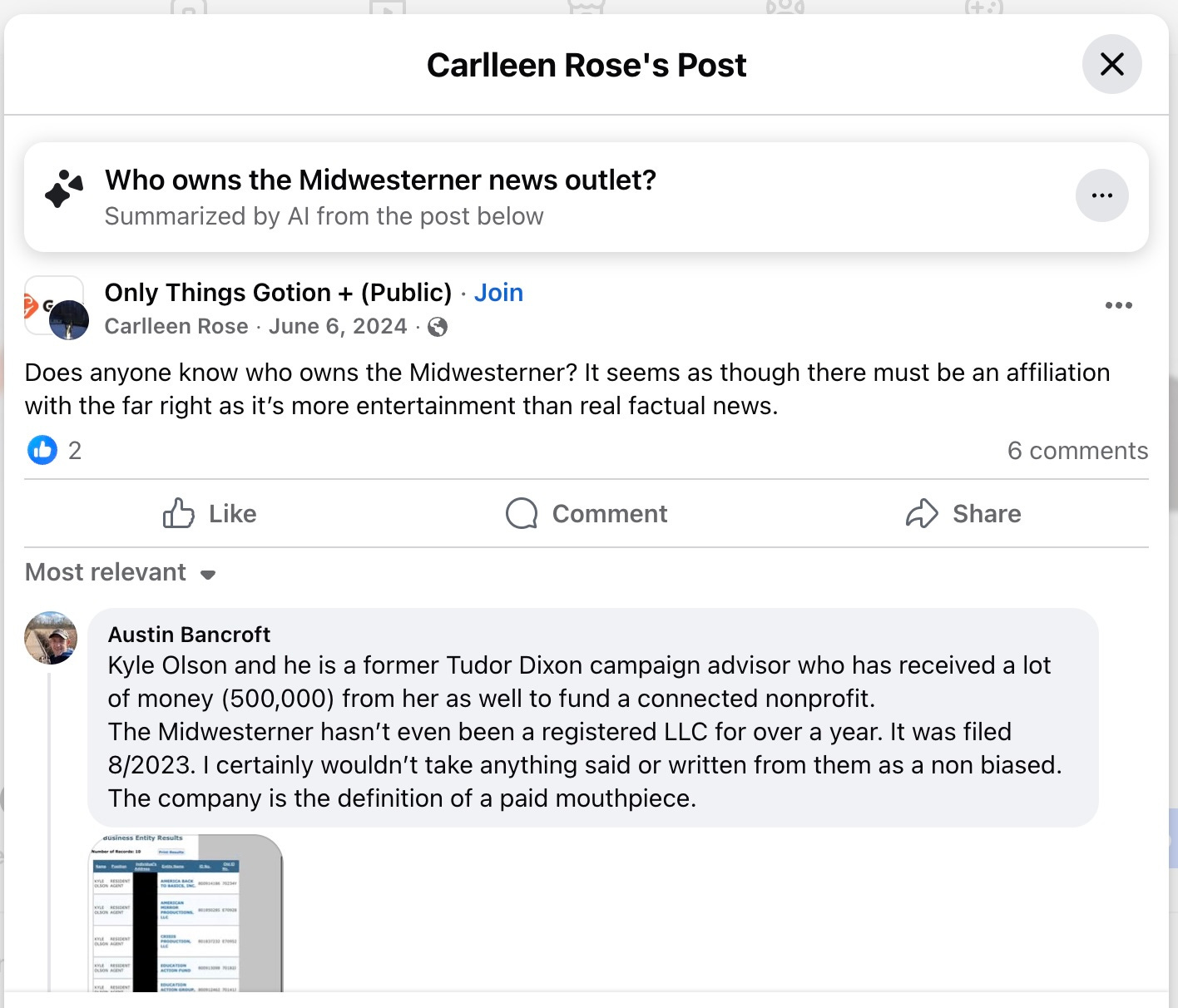
Tudor Dixon, you’ll recall, is the conservative media figure and Republican gubernatorial candidate who lost to Gretchen Whitmer in the 2022 Michigan blue wave. Dixon’s candidacy and that election could be a book unto themselves, including massive primary voter fraud shenanigans and Dixon blasting out her own party’s internal postmortem, which blamed her candidacy for dragging down the state ticket.
But what’s important for our purposes is that the Midwesterner, the pink slime website pumping out anti-Democrat content, was apparently created and owned by a known associate of the Republican candidate who lost to Gretchen Whitmer in 2022? That… seems relevant.
So I kept digging. And struck gold.
